


Last Updated: November 5, 2026
Quick Summary
To identify authentic American made leather journals, check the cover grade first: full-grain leather is the top layer of the hide and is the premium choice, while genuine leather is usually a lower, coated layer. Then verify any Made in USA claim by asking where the hide was tanned and where the stitching, hardware, and paper were made, since origin claims can be partial.
- Full-grain leather is the top hide layer and ages with a richer patina.
- Genuine leather is often a lower layer that may be coated with plastic or polyurethane.
- An unqualified Made in USA claim should mean all or virtually all components are American.
- Ask sellers separately where the hide, thread, hardware, and paper come from.
- Saddle stitching holds up better because a broken stitch does not unravel the seam.
Table of Contents
- Start With the Leather: Full-Grain vs. Genuine Leather
- Evaluating Craftsmanship: Stitching, Binding, and Finish
- Telling Real Leather From Vegan and Misleading Terms
- Choosing a Refillable Personalized Leather Journal
- Ordering Your Journal With Confidence
- Frequently Asked Questions
Start With the Leather: Full-Grain vs. Genuine Leather
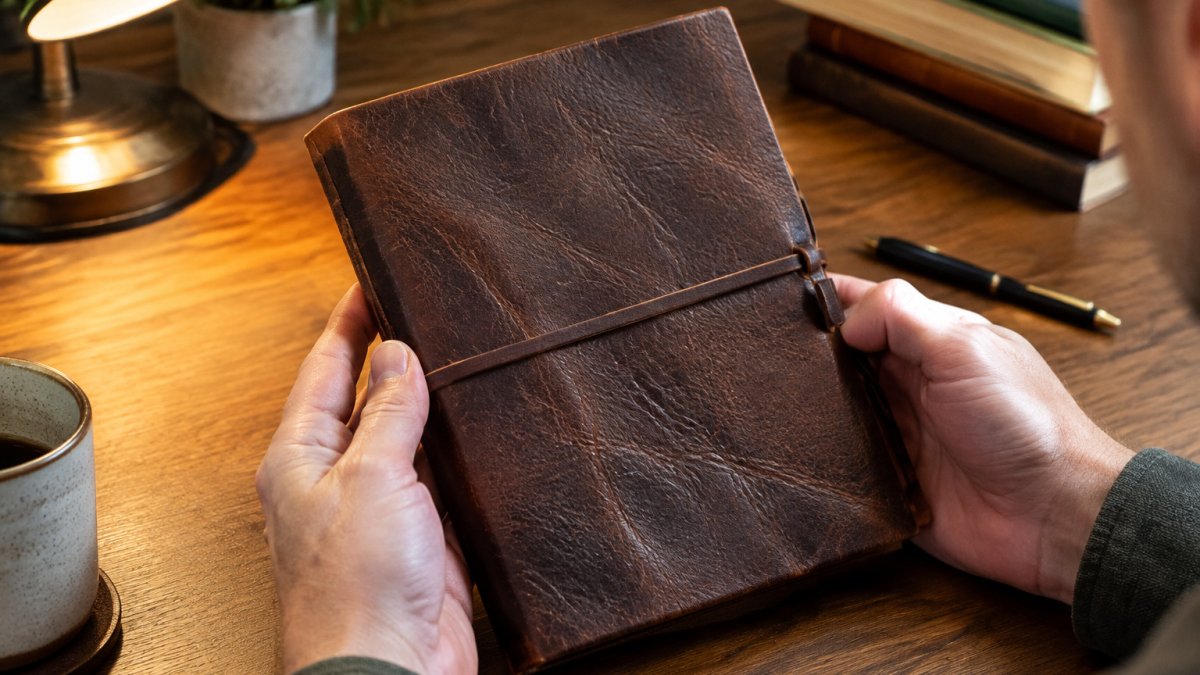
Learning how to identify authentic American made leather journals starts with the cover material, because that is where most of the value lies in any leather journal.
A common pattern is a qualified claim, "Assembled in USA," "Made in USA of imported leather," or "Sewn in the USA from domestic and imported materials." Qualified claims are not automatically dishonest, but they are narrower than they sound.
Watch out: a seller who uses "Made in USA" in the headline but describes imported leather or hardware in the body copy is signaling a qualified claim without labeling it as one. For a step-by-step method, see how to verify American made claims.
Component-by-Component Origin Transparency
The most transparent sellers disclose origin one component at a time. When you compare journals, ask for each of these separately:
- Hide: Which country was the animal raised and slaughtered in, and where was the hide tanned?
- Tanning: Was the leather vegetable-tanned or chrome-tanned, and at which tannery?
- Thread: Is the stitching thread domestic or imported, and is it waxed linen, polyester, or nylon?
- Hardware: Where were the clasps, rings, snaps, and closures made?
A journal can legitimately be called American-made while some of these components are imported, but the seller should say so. If a listing answers the assembly question and goes silent on the hide and hardware, treat the origin claim as partial until you get specifics.
Questions to Ask a Seller About Origin
Before you order, ask direct questions and notice which ones get answered:
- Where is the leather tanned, and where is the hide cut?
- Where are the stitching, binding, and final assembly done?
- Are the hardware and paper made in the USA or imported?
- Can you name the workshop or city where the journal is made?
A seller who answers clearly and volunteers the imported parts is usually more trustworthy than one who repeats "Made in USA" without detail. A seller who avoids the component questions, or answers only the easiest one, is telling you something too.
Evidence Beyond the Label
Labels are a starting point, not proof. Look for maker videos or workshop photos that show the cutting table, the stitching, and the finishing steps, a real workshop has distinctive tools, benches, and lighting that are hard to fake consistently. Construction photos should show the underside of the cover, the spine, and the edge finish, not just the top surface.
Evaluating Craftsmanship: Stitching, Binding, and Finish
Craftsmanship is where a leather journal earns or loses its price. Turn the journal over and look closely at the edges, spine, and corners, because those spots wear first and reveal how well the cover was built. The goal is not to admire the surface but to judge whether the journal can be used daily and repaired later.
Stitching: What Even Stitches Tell You
Check the stitching along the spine and around the cover. Stitches should be even, tight, and evenly spaced, with no loose threads, skipped holes, or gaps. Saddle stitching, two needles working the same thread from both sides, is stronger than a single line of machine lockstitch because a broken stitch in saddle stitching does not unravel the seam.
Watch out: stitching that runs through a thin, coated split rather than a solid full-grain cover will tear out at the holes long before the thread itself fails.
Binding: How the Journal Opens and Wears
A well-bound journal lies flat when opened and does not pull loose from the spine. Pages should sit straight and stay attached after light use. Look at how the text block is attached to the cover, glued, sewn, or both. A sewn text block with a reinforced spine holds up better than a glued block, which can crack and shed pages over time.
Finish: Edges, Corners, and Hardware
Edges should be smooth, burnished, or painted cleanly, not rough or sloppily glued. Corners should be neat and not peeling. Hardware, clasps, rings, snaps, and closures, should be solid and firmly set, with no spinning rivets or loose posts. On a refillable journal, the closure is a wear point, so check that the elastic or strap is replaceable. For more quality checks on personalized gifts, read personalized gift quality assurance tips.
Repairability and Expected Lifespan
A journal built to last is one that can be repaired. Ask whether the maker offers restitching, hardware replacement, or cover refinishing, and whether replacement inserts are standard sizes you can buy later. Full-grain covers with saddle stitching and solid hardware can last for years with care; coated splits and glued bindings tend to fail sooner. The trade-off is price, repairable construction costs more up front but spreads the cost over a longer life.
So Proud Of You - Leather Journal →
A Repeatable Buyer Comparison Framework
Use the same scorecard for every journal you compare so the decision is consistent:
- Origin evidence: Does the seller disclose hide, tanning, thread, hardware, paper, and assembly separately?
- Leather grade: Is it full-grain, top-grain, or a coated split, and is the thickness stated?
- Construction: Saddle-stitched or machine-stitched, sewn or glued text block, burnished edges?
- Repairability: Restitching, hardware replacement, and standard-size refills available?
Score each journal on the same five lines and the strongest option usually becomes obvious. A journal that answers every line clearly is a better bet than one that wins on appearance alone.
The article's craftsmanship checks come down to a few telltale features, summarised below so you can compare journals quickly.
| Feature | What to look for | Why it matters |
|---|---|---|
| Stitching | Even, tight, no skipped holes | Shows build quality |
| Stitch method | Saddle stitching | Broken stitch does not unravel |
| Binding | Lies flat, pages stay attached | Holds up under daily use |
| Text block | Sewn, or sewn and glued | Sewn resists cracking better |
| Edges and corners | Smooth, neat, not peeling | Shows finishing care |
| Hardware | Solid, firmly set, no spinning rivets | Resists loosening over time |
Telling Real Leather From Vegan and Misleading Terms
Many journals use terms like "vegan leather," "faux leather," or "PU leather." These materials are not the same as real leather, and they do not age the same way. Vegan leather is not automatically a bad choice, but it should be labeled honestly.
Look for these warning signs:
- The product says "leather" without naming the type
- The description uses "premium leather" with no grade
- The cover feels plastic-smooth with a uniform pattern
- There is no information about the material beneath the surface
A quick test is to look at the grain. Real leather shows slight variation and natural pores. Synthetic covers often look too even.
Choosing a Refillable Personalized Leather Journal
A refillable journal lets you swap paper inserts over time, which can extend the life of the cover.
Look for a cover with a secure closure, a sturdy spine, and standard-size inserts you can buy later.
A personalized option is the People, Places, Memories Journal from The Basket Filler. You can also browse a similar personalized refillable journal before deciding. You can view it here: shop the People, Places, Memories journal.

Keep in mind that this journal uses vegan leather and is custom made to order, so check the material against what you are looking for.
Ordering Your Journal With Confidence
Before you buy, run through a short checklist. Confirm the leather grade, the origin claim, and the craftsmanship details. Ask the seller any question that remains open.
Once you know what to look for, shopping becomes simpler. Use the checks above to narrow your options, then choose the journal that fits the person and the occasion. Journals in this range are made to order, so check the listing details before you check out.
Frequently Asked Questions
Where can I find leather journals made in the USA?
Look for independent makers and small American businesses that state their manufacturing location on the product page, and check whether they name where the leather was tanned and where the journal was assembled. The Basket Filler, for example, designs and assembles most of its products in the USA, but its leather journal listings are vegan leather with printed covers, so read each listing's material description before you buy. Ask the seller directly if the details are missing.
How can I tell whether a journal cover is real leather?
Genuine leather has irregular pores, slight color variation, and a natural smell, while faux leather looks uniform and often feels plastic-like when bent. Check the product description for the words full-grain, top-grain, or genuine leather, and be cautious of vague terms like leatherette or PU leather, which indicate synthetic material. A listing that names no leather grade usually means the cover is not real leather.
What is the difference between full-grain and genuine leather?
Full-grain leather is the top layer of the hide with its original grain intact, making it the strongest and most durable grade, and it develops a patina over time. Genuine leather is a lower grade made from split or corrected layers, which is why the label sounds premium but the quality is typically lower. Full-grain costs more but generally lasts longer in a journal that gets daily handling.
What details should I check when assessing a leather journal's craftsmanship?
Examine the stitching for even, tight lines with no loose threads, check that the binding lies flat when the journal is opened, and confirm the corners are neatly finished. Look for the cover thickness and the page count in the listing, and check that any closure band, ribbon bookmark, or elastic fastener is firmly attached. Sellers that list specific dimensions and materials usually have more confidence in their construction.


