


Quick Summary
Weighted blankets can be safe for some elderly parents, but not everyone. Check with a doctor first if your parent has breathing, heart, circulation, mobility or dementia concerns, and start with a lighter weight.
- Talk to a doctor first if your parent has breathing, heart, circulation or mobility problems.
- Weighted blankets can add pressure on the chest, so never let one cover the face or neck.
- Start at the lower end of the weight range, often 5% to 7% of body weight for older adults.
- Choose a blanket your parent can lift off without help.
- Evidence for weighted blankets in dementia is thin, so treat them as a comfort measure, not a treatment.
Table of Contents
- Why Families Ask Whether Weighted Blankets Are Safe for Elderly Parents
- Who Should Check With a Doctor First
- Weighted Blanket Safety for Elderly Adults: Breathing, Circulation and Overheating
- Weighted Blankets and Dementia: What the Evidence Shows and Where Caution Is Needed
- How to Choose a Safe Weighted Blanket Weight for an Older Adult
- Caregiver Safety Checklist for Nighttime Use
- Alternatives to Weighted Blankets for Seniors
- Choosing a Cozy Blanket Your Parent Can Easily Manage
- Frequently Asked Questions
Why Families Ask Whether Weighted Blankets Are Safe for Elderly Parents
Weighted blankets have moved from sleep clinics into living rooms, and many families now wonder whether one is safe for a parent. The short answer is that they can be, for some older adults, but not for everyone. The right answer depends on health, mobility and who is around at night.
Most families ask because a parent is restless, anxious or struggling to sleep. A heavy blanket looks like a gentle fix. Yet older bodies handle pressure, heat and restriction differently than younger ones, and that difference matters.
This guide walks through seven steps to check whether a weighted blanket fits your parent. It covers who should talk to a doctor first, the main physical risks, what the evidence says about dementia, how to pick a safe weight, and a checklist for nighttime use. It also covers gentler alternatives.
At The Basket Filler, we offer cozy blankets chosen with care for someone we love.
Who Should Check With a Doctor First
Some older adults should not use a weighted blanket until a clinician signs off. Talk to a doctor before use if your parent has any of the following:
- Breathing problems, such as COPD, sleep apnea or asthma
- Heart disease or poor circulation
- Trouble moving in bed or getting out of it
- Frailty, weakness or a recent fall
- Skin that bruises or breaks down easily
- Dementia or confusion that affects their safety
A doctor can weigh the risks against any benefit. They may also suggest a lower weight, a shorter trial, or another option entirely.
Weighted Blanket Safety for Elderly Adults: Breathing, Circulation and Overheating
Three physical concerns come up most often with heavy bedding in older adults.
Breathing. Weight on the chest and shoulders can make breathing harder. This is a bigger concern for anyone with lung or heart conditions. A blanket should never cover the face or sit high on the neck.
Circulation. Pressure on the legs and body can affect blood flow in people with vascular disease. Watch for swelling, color changes or numbness after a night under the blanket.
Overheating. Weighted blankets hold heat. Older adults often have a weaker sense of temperature, so they may not notice they are too warm. Choose breathable covers, such as cotton, and keep the bedroom cool.
Many families find that a blanket which feels pleasant at bedtime becomes a problem only in the early morning hours. Check on your parent during the night when you can.
The article flags three physical concerns that come up most often with heavy bedding in older adults.
| Concern | Who it affects most | What to watch for |
|---|---|---|
| Breathing | Adults with lung or heart conditions | Weight on chest and shoulders; never cover face or neck |
| Circulation | Adults with vascular disease | Swelling, color changes or numbness after a night under it |
| Overheating | Older adults with weaker temperature sense | Choose breathable cotton covers and keep the bedroom cool |
Weighted Blankets and Dementia: What the Evidence Shows and Where Caution Is Needed
Many caregivers hope a weighted blanket will calm a parent with dementia or reduce nighttime wandering. Some families report better rest and less agitation. The honest answer is that the evidence specific to older adults with dementia is thin, and it should not be confused with the much larger body of research on children, autism, or general anxiety.
What the research actually covers. Most published studies on deep-pressure therapy involve children with autism or adults with generalized anxiety, not seniors with dementia. The studies that do include older adults with dementia tend to be small, short, and mixed in their results. Some report modest improvements in agitation or sleep onset; others find no meaningful difference. A common pattern in the literature is that benefits, when they appear, are modest and highly individual, not a reliable treatment effect you can count on.
Why the risk profile is different in dementia. A cognitively intact adult can say "this is too heavy" or "I'm too warm" and push the blanket off. A parent with dementia may not be able to report discomfort, may not recognize the need to remove the blanket, and may not have the strength or coordination to pull it off in an emergency. Restlessness can escalate into a struggle under a heavy blanket, which raises the risk of falls, skin injury, and distress. In advanced dementia, the blanket can effectively become a restraint, which is neither safe nor appropriate.
Questions to bring to the care team. Before trying a weighted blanket, ask the parent's physician or memory-care clinician:
- Is there any respiratory, cardiac, or circulatory condition that makes chest or body pressure unsafe?
- Can this person reliably remove the blanket independently, or will supervision be required?
- Is the current stage of dementia one where the person can communicate discomfort?
- Does the care setting (home, assisted living, memory care) have a policy on weighted blankets?
Treat a weighted blanket as one possible comfort measure among many, not a treatment for dementia. If the care team is uncertain, start with lighter alternatives and revisit the question as the parent's needs change.
How to Choose a Safe Weighted Blanket Weight for an Older Adult
The widely repeated guideline is a blanket about 10% of body weight. For older adults, most practitioners recommend starting lower, often 5% to 7%, or using a lighter throw. Frail, thin, or recently hospitalized adults may need less still, and some should not use one at all.
Screen for contraindications first. Weight selection is secondary to whether a weighted blanket is appropriate. Consult a clinician before use if your parent has any of the following:
- Chronic respiratory disease (COPD, asthma, sleep apnea) or any condition that makes breathing against chest pressure difficult
- Heart failure, poor circulation, or a history of blood clots
- Limited mobility, frailty, or a recent fall that affects their ability to reposition or remove the blanket
- Skin that bruises or breaks down easily, or a history of pressure injuries
- Dementia or confusion that affects their ability to communicate discomfort or remove the blanket
If any of these apply, a lighter throw or a non-weighted alternative is usually the safer first step.
Individualized weight selection. Rather than applying the 10% rule mechanically, work through these factors:
- Body weight and overall strength, a 110-lb parent and a 180-lb parent should not receive the same blanket
- Ability to lift and remove the blanket independently while lying down
- Bed size and how the blanket drapes, it should cover the body without reaching the face or neck
- Any history of breathing, circulation, or skin problems
- Whether the parent sleeps alone or has overnight supervision
A gradual trial process. A common pattern among clinicians and experienced caregivers is a staged trial rather than an all-night commitment:
- Calculate 5% and 10% of your parent's body weight to establish a range.
- Start at the lower end, and place the blanket on the legs and lower body only, not the chest.
- Have your parent practice lifting and removing the blanket while awake and alert.
- Use it for short periods first, a nap or quiet time in a chair, not overnight.
- Check skin, breathing, color, and comfort after each trial.
- Increase weight or duration slowly only if your parent is comfortable and a clinician agrees.
- Stop immediately if confusion, distress, breathing changes, or skin redness appear.
What to observe after use. Check for redness or pressure marks on the skin, swelling or color changes in the legs, and any signs of overheating such as flushing or damp skin. Ask your parent how they felt, and if they cannot reliably report, rely on your own observation and a night monitor.
Caregiver Safety Checklist for Nighttime Use
Use this list before and during nighttime use:
- A clinician has approved use
- The blanket weight is at the lower end of the safe range
- Your parent can lift it off without help
- It never covers the face, neck or mouth
- The bedroom stays cool and well ventilated
- Someone checks on your parent during the night
- Bed rails, lighting and a clear path to the bathroom are in place
- You check the skin for redness or pressure marks each morning
Consider a night monitor if your parent wanders or has trouble breathing while asleep.
Alternatives to Weighted Blankets for Seniors
If a weighted blanket is not right for your parent, several gentler options can help with comfort and rest:
- A lightweight throw or quilt that adds warmth without pressure
- A soft fleece or sherpa blanket for cozy evenings in a chair
- A warm bath or shower before bed to ease tension
- A consistent bedtime routine with dim lights and quiet music
- A heating pad on low placed away from the skin, used only with supervision
- Gentle massage or stretching guided by a physical therapist
Many of these options cost little and carry fewer risks.
Choosing a Cozy Blanket Your Parent Can Easily Manage
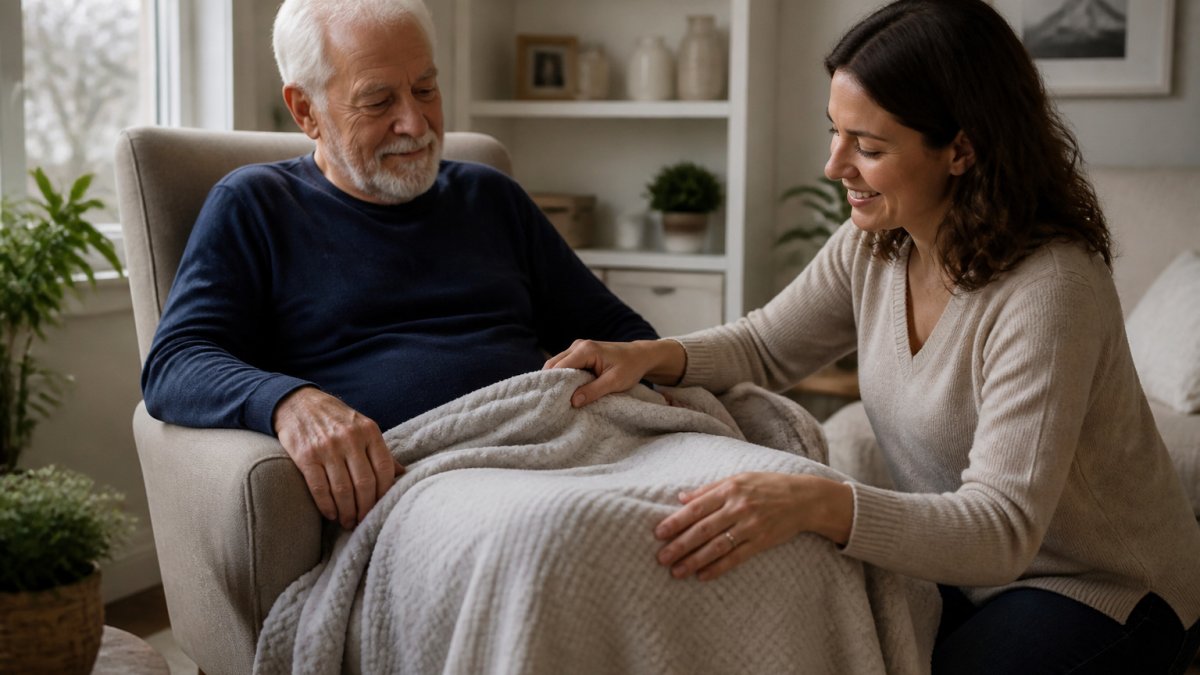
For many older adults, the best blanket is one they can easily handle. Look for something light, soft and simple to move. Fleece and sherpa throws offer warmth without heavy weight, and they are easy to pull up or push aside. Compare the two in fleece vs sherpa blankets for cold winters.
Prioritize comfort and independence. A blanket your parent can manage alone is safer than one that needs a caregiver to adjust it.
For a closer comparison of materials, our guide on fleece vs sherpa blankets for cold winters can help you choose.
We hope these steps help you make a confident, caring choice for your parent's rest and safety.
Frequently Asked Questions
Would a weighted blanket help a person with dementia?
Some caregivers report that a weighted blanket seems to calm restlessness or help a parent settle at night, but published evidence in people with dementia is limited and small in scale. Anecdotal benefit is not proof of safety. Before trying one, talk with your parent's doctor, especially if your parent wanders, cannot easily remove bedding, or has trouble communicating discomfort. If you do try one, start with a light setting, supervise the first nights, and stop if your parent seems agitated, overheated or distressed.
Should you ask a doctor before an older adult uses a weighted blanket?
Yes. A doctor should review any weighted blanket before use if your parent has heart or lung disease, sleep apnea, circulation problems, limited mobility, frailty, or a condition that affects temperature regulation. Your parent's physician can also advise on a safe weight range, which is often a percentage of body weight. Bring the blanket's label or product details to the appointment so the discussion is specific.
Can weighted blankets cause overheating or make it harder to breathe?
They can. Heavy, dense fabric can trap heat, and a blanket that rests on the chest or face can make breathing more difficult, particularly for someone with respiratory illness. Keep the blanket below the neck, and check that your parent can push it off without help. Feel the skin on the neck and chest periodically to make sure your parent is not too warm or sweaty.
What is a safer alternative to a weighted blanket?
A soft fleece throw or a lightweight quilt can offer warmth. The Basket Filler offers cozy blankets and home decor, and current options and pricing are available on its website.


