


Table of Contents
- Custom Jewelry vs Mass-Produced Jewelry: The Core Differences
- Recycled Gold Jewelry and Sustainable Materials in Custom Production
- Environmental Impact: Custom Sustainable Jewelry vs Mass-Market Production
- How to Choose Sustainable Jewelry: A Decision Framework
- Is Sustainable Jewelry Worth the Investment?
- Custom Personalized Necklaces: A Sustainable Gift Option
- Frequently Asked Questions
Last Updated: October 18, 2026
Custom Jewelry vs Mass-Produced Jewelry: The Core Differences
The choice between custom jewelry and mass-produced pieces shapes what you wear, how long it lasts, what it costs over time, and whether you're supporting ethical production. At The Basket Filler, we help customers understand these differences so they can make informed decisions.
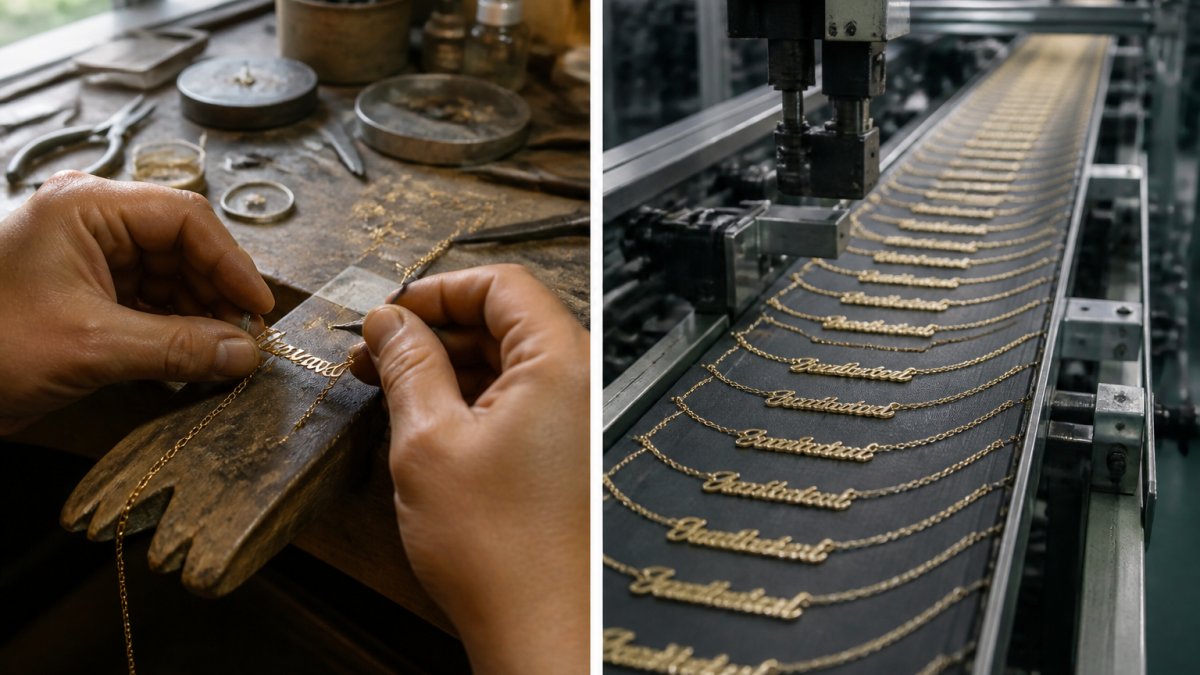
Custom jewelry vs mass-produced jewelry represents fundamentally different approaches to design, production, and value. Custom pieces are made-to-order for individual customers; mass-produced jewelry is manufactured in high volumes using standardized designs. The implications ripple across quality, sustainability, cost, and longevity.
How Production Methods Shape Quality and Longevity
Handmade jewelry and artisan production prioritize individual craftsmanship. A jeweler works directly with materials, making real-time adjustments to fit, finish, and durability, with focused attention from start to finish.
Mass-market jewelry relies on assembly lines and standardized molds, where speed and consistency matter more than customization.
This difference shows up in durability. Custom pieces often use higher-quality materials and construction because the maker's reputation depends on longevity.
Repairability matters too. A custom jeweler can often repair or modify their own work because they understand exactly how it was made.
Design Customization and Personalization
Personalization is where custom jewelry shines. You control the design, materials, size, and finish, a necklace with your child's name, a ring in a specific metal, a pendant that matches your aesthetic.
Mass-market jewelry offers limited personalization. You choose from existing designs and finishes; some retailers offer basic engraving, but the core design is fixed. You're selecting from what's already been manufactured, not creating something new.
This matters for fit and function. A custom ring can be sized precisely to your finger. A custom necklace can be adjusted to your preferred length.
Recycled Gold Jewelry and Sustainable Materials in Custom Production
Sustainable materials and sourcing matter increasingly to buyers who care about environmental impact.
Recycled metals reduce mining impact. Reclaimed gold comes from existing jewelry, industrial waste, or electronic recycling, requiring no new mining, no water consumption for extraction, and no land damage.
Ethically sourced stones and traceable gemstones tell you where your diamond or sapphire came from. Responsible sourcing means fair labor practices, no conflict financing, and transparent supply chains.
Mass-produced jewelry often comes from large-scale suppliers where material provenance is harder to track. The supply chain is longer and more opaque.
Environmental Impact: Custom Sustainable Jewelry vs Mass-Market Production
Most comparisons stop at "custom is greener." That claim doesn't survive scrutiny. Environmental impact depends on six lifecycle stages, and custom versus mass-market changes the math at each one. Below is a stage-by-stage comparison with assumptions stated, so you can evaluate a specific piece rather than a slogan.
Stage 1: Metal Input, Mined vs Recycled
Gold and silver carry most of a jewelry piece's embodied impact, and the metal's source matters more than any other variable.
- Recycled gold comes from existing jewelry, industrial scrap, or e-waste. It requires no new mining, no new ore processing, and no new land disturbance. The refined metal is chemically identical to newly mined gold.
- Newly mined gold requires ore extraction, crushing, chemical processing, and refining. The exact footprint varies enormously by mine and country of origin.
A custom jeweler working in small batches can usually tell you whether the metal is recycled or newly mined, and can often name the refiner. A mass-market piece may blend both across a large production run, making the input impossible to verify at the item level. That traceability gap, not the metal itself, is the real difference.
Stage 2: Gemstone Sourcing
Lab-grown diamonds and traceable natural stones change the impact profile, but only if you can confirm origin.
- Lab-grown diamonds are produced in controlled facilities rather than mined. They avoid mining disturbance, but they are energy-intensive, and the grid powering the facility determines much of their footprint.
- Traceable natural stones can be responsibly sourced, but "traceable" must mean a documented chain from mine to cutter to setter, not a general statement of good intentions.
Custom makers who buy stones individually can often pass along a grading report and origin documentation. Mass-market supply chains pass through multiple intermediaries, so origin is frequently unknown at retail.
Stage 3: Manufacturing and Waste
This is where small-batch production has a structural advantage, but it is not automatic.
- A custom jeweler ordering 10 grams of gold for one ring uses approximately that amount. Offcuts are typically saved and reused.
- A factory producing thousands of identical pieces generates scrap, but most large manufacturers run closed-loop precious-metal recycling, so the scrap is recovered rather than lost.
The real difference is overproduction. Mass-market jewelry is made to forecast, and unsold inventory is a form of waste that custom made-to-order production avoids by design. A custom piece is made because someone ordered it.
Stage 4: Shipping and Packaging
Custom pieces usually ship individually; mass-market pieces ship in bulk to a distribution center, then to the customer. Per-item shipping impact is often higher for custom because there is no consolidation. Packaging is a wash unless one side uses plastic-free, recyclable materials, ask before assuming.
Stage 5: Use, Repair, and Replacement
This stage usually dominates the lifetime footprint, and it is the one most comparisons ignore.
- A piece worn daily for 20 years and repaired twice has a very different footprint than a piece replaced every two years.
- Repairability extends life. A custom jeweler who made the piece can often resize, re-tip prongs, or replace a stone. A mass-market piece may be unrepairable or uneconomical to repair.
Stage 6: End of Life
Precious metal is recyclable almost indefinitely. A custom piece with high metal content retains scrap value; a plated or base-metal mass-market piece may have little or no recovery value. Design for disassembly and material purity improve end-of-life outcomes.
Classic Paw Print Name Necklace →
How to Verify Claims and Spot Greenwashing
Sustainability language is cheap. Evidence is not. Use these checks:
- Ask for documentation, not adjectives. "Recycled 14K gold, refiner certificate available" is verifiable. "Eco-friendly gold" is not.
- Look for third-party certification. The Responsible Jewellery Council certifies responsible sourcing practices across the supply chain. Fair trade certifications verify labor standards. Gemological grading reports confirm stone identity and, for lab-grown stones, origin type.
- Check chain-of-custody evidence. Can the maker name the refiner, the stone supplier, and the setting workshop? A short, named supply chain is easier to verify than a long, anonymous one.
- Watch for vague claims. "Ethical sourcing," "conscious collection," and "planet-friendly" without specifics are red flags, not proof.
- Ask about the grid. For lab-grown stones, the energy source of the production facility matters more than the label.
How to Choose Sustainable Jewelry: A Decision Framework
Choosing between custom sustainable jewelry and mass-market options depends on your priorities. Use this framework.
| Priority | Best Choice | Why |
|---|---|---|
| Personalization & uniqueness | Custom | You control design, materials, fit, and finish |
| Environmental impact | Custom (with verification) | Easier to verify materials and sourcing; less waste |
| Fast delivery | Mass-market | Mass production is faster; custom has lead times |
| Lower upfront cost | Mass-market | Custom typically costs more initially |
| Longevity & repairability | Custom | Handmade pieces last longer; easier to repair |
| Fair labor & ethical sourcing | Custom (verified) | Easier to track supply chain and labor practices |
| Wide design selection | Mass-market | More options to choose from immediately |
| Investment value | Custom (handmade) | Artisan pieces often hold or increase in value |
Evaluating Cost Per Wear and Long-Term Value
Price is the first thing people notice. Custom jewelry costs more upfront, a custom handmade necklace might cost more than a mass-produced equivalent.
But cost per wear tells a different story. If a mass-produced necklace breaks after 2 years and a custom piece lasts 20, the math shifts.
Consider this: A $30 mass-produced necklace worn 200 times before breaking costs $0.15 per wear.
Durability, repairability, and emotional value matter too. A piece you love enough to wear forever is worth more than something you'll discard in a few years.
Lead Times, Minimums, and Custom Production Trade-Offs
Custom production takes time. Lead times typically range from 2 weeks to 3 months, depending on complexity and the maker's schedule.
Some custom makers have minimums, they won't make a single piece below a certain order value. This is less common for jewelry but worth asking about.
Design revisions add time. If you want changes after seeing a draft, that extends the timeline. Clear communication upfront reduces back-and-forth.
Mass production has the advantage of speed. You can buy today and receive in days. If timing is critical, mass-market wins.
Is Sustainable Jewelry Worth the Investment?
Yes, sustainable jewelry is worth the investment if you prioritize longevity, ethical production, and environmental impact.
A sustainable piece, whether custom or carefully selected mass-market, holds its value better. It's less likely to break, tarnish, or disappoint.
Ethically made jewelry supports fair labor and responsible sourcing. Your purchase funds better working conditions and environmental practices.
Handmade, custom sustainable jewelry often becomes an heirloom. It's one-of-a-kind, made with intention, and built to last generations.
The trade-off: You pay more upfront and wait longer for delivery. If you need something immediately or have a tight budget, mass-market is the practical choice.
Custom Personalized Necklaces: A Sustainable Gift Option
Custom personalized necklaces are one of the best sustainable gift choices because they combine personalization, longevity, and emotional meaning.
A name necklace or custom pendant becomes something the wearer treasures. They're more likely to wear it regularly, which means it lasts longer and delivers more value.

The Basket Filler offers custom name necklaces starting at $29.39, made in the USA with your choice of polished stainless steel or 18K yellow gold finish. Options include the Classic Style Name Necklace, the Signature Style Name Necklace with contemporary font, the Classic Heart Style Name Necklace, the Classic Paw Print Name Necklace for pet lovers, and the Classic Vertical Name Necklace at $40.42.


Each necklace is made in the USA and arrives in a complimentary soft-touch gift box.
Choosing between custom and mass-market jewelry comes down to what matters most to you. If personalization, longevity, and ethical sourcing matter, custom sustainable jewelry is the better investment.
Frequently Asked Questions
Is custom jewelry more sustainable than mass-produced jewelry?
Custom jewelry typically produces less waste because it's made to order in the exact quantity needed, eliminating excess inventory and overproduction. Mass-market jewelry often involves large production runs, with unsold pieces ending up in landfills. Custom makers also tend to use recycled metals and ethically sourced gemstones more frequently than mass producers. However, sustainability depends on the specific maker's practices, verify material sourcing and production methods before purchasing.
How can you tell whether jewelry is ethically made?
Look for transparent supply chain documentation, certifications from recognized standards bodies, and direct information about where materials come from and how workers are treated. Ethical makers provide details about their sourcing practices and often share the story behind their pieces. Ask questions: Where are metals sourced? Are gemstones conflict-free? Are workers paid fair wages? Reputable custom jewelers will answer these questions clearly. Be skeptical of vague claims like 'eco-friendly' without supporting evidence.
What is the difference between handmade and mass-produced jewelry?
Handmade jewelry is crafted by artisans, often one piece at a time, allowing for customization and attention to detail. Mass-produced jewelry is manufactured in factories using machines and assembly lines to create identical pieces quickly and cheaply. Handmade pieces typically last longer due to superior craftsmanship and materials, while mass-produced items often use lower-quality materials and assembly methods. Handmade jewelry also supports individual makers and small businesses, whereas mass production prioritizes volume and profit margins.
Is sustainable jewelry worth the higher price?
Yes, when you consider long-term value. Sustainable custom jewelry costs more upfront but lasts decades or longer due to better materials and craftsmanship, lowering your cost per wear. Mass-market pieces may need replacement within a few years, adding up to higher total spending. Beyond economics, sustainable choices reduce environmental harm and support ethical labor practices. For meaningful gifts and investment pieces, the higher initial cost pays off through durability, beauty, and the knowledge that your purchase aligns with your values.


