


Table of Contents
- Minted vs Boutiques: What Actually Matters When You Order
- Custom Gift Quality: Paper, Print, and Materials Compared
- Personalized Gift Shipping Time: Production vs Delivery
- Custom Gifts From Small Businesses: What You Get Beyond the Product
- Personalized Gifts With Fast Shipping: How to Vet a Seller Before You Order
- Like-for-Like Total Cost: Why Boutique Pricing Looks Higher
- Returns, Reprints, and What Happens When Something Goes Wrong
- Conclusion: Choosing Between Scale and Craft
- Frequently Asked Questions
Last Updated: October 7, 2026
Minted vs Boutiques: What Actually Matters When You Order
The minted vs boutiques decision comes down to scale and predictable ordering versus craft and direct accountability. This guide from The Basket Filler breaks down quality, speed, and total cost.
The real difference is how each handles mistakes: a big site resolves problems through a support queue, a boutique through the person who made the item.
Worth knowing: the FTC's guidance on advertising and endorsement claims requires sellers to be truthful about guarantees and materials, which is why "made in the USA" and "100% satisfaction" claims are verifiable promises, not marketing noise.
Custom Gift Quality: Paper, Print, and Materials Compared
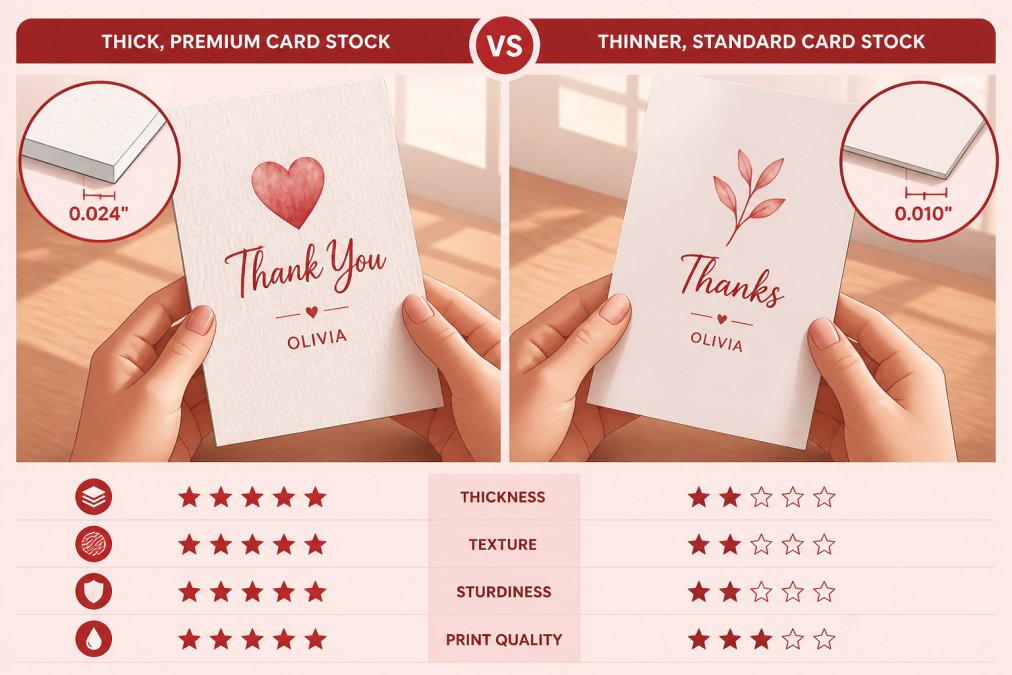
Quality in personalized gifts is a set of measurable attributes you can ask about before you order. Apply this rubric to any seller across the four dominant categories: cards and stationery, apparel and textiles, jewelry, and home decor.
The Five-Point Quality Rubric
Score any seller on these five dimensions. Large platforms score high on consistency and low on ceiling; boutiques score high on ceiling but vary on consistency.
- Substrate or material spec. Is the paper weight, fabric blend, metal type, or wood species stated on the listing? A stated spec is a promise; "premium materials" is not.
- Print or finish method. Digital, offset, foil stamp, letterpress, UV, embroidery, engraving, dye-sublimation. Each has a different failure mode.
- Color management. Does the seller proof in CMYK, offer a physical sample, or warn you that screen color will shift?
- Personalization accuracy controls. Is there a human proofread step, a spell-check pass, or a customer-approval gate before production?
- Packaging and transit protection. Rigid mailer, tissue, box, sleeve, packaging is the last quality step and the first thing the recipient sees.
Paper Weight and Print Finish: What the Numbers Mean
Paper weight is expressed two ways in the U.S.: pounds (lb) for text and cover stock, and GSM (grams per square meter). Practical ranges for personalized cards and stationery:
- 80-100 lb text (roughly 104-148 GSM): standard greeting-card and invitation stock. Feels like a good card, not a luxury one.
- 110-130 lb cover (roughly 200-300 GSM): the sweet spot for wedding invitations and premium stationery. Noticeably stiff, holds an edge, resists show-through.
- Double-thick or 200 lb+ cover (roughly 400+ GSM): letterpress and foil territory. Expensive, heavy, and the stock most boutiques default to for wedding suites.
If a listing does not state a weight, ask. A seller who cannot answer is either reselling or has never spec'd the paper.
Print finish changes how a design reads in the hand. Matte reads soft and editorial; gloss pops color but shows fingerprints. Foil stamping fuses metallic film in a separate pass, so it costs more and misregistration is the most common defect.
Color Accuracy and Personalization Accuracy
Color accuracy is the gap most buyers discover too late. Screens render in RGB; print uses CMYK, and the two never match, a red rose on your monitor can arrive as muted brick red, because CMYK cannot reproduce some RGB colors, especially saturated greens and oranges.
Personalization accuracy is simpler to protect against. Spelling mistakes and wrong dates usually trace back to one thing: no human proofread the order before production.
Where Large Platforms and Boutiques Actually Diverge
Large platforms win on consistency: the same file, press, and operator training, millions of times, a real advantage for a 200-piece order that must look identical.
Boutiques win on ceiling. A letterpress operator running 30 wedding suites a month will catch a registration issue a high-volume shop would ship.
The trade-off is variance: a boutique's output depends on the maker, their workload, and their equipment.
Personalized Gift Shipping Time: Production vs Delivery
Personalized gift shipping time has two separate clocks, and sellers often quote only the shorter one. Processing time is how long the item takes to make; delivery time is how long it takes to reach your door. A "ships in 3 days" promise says nothing about arrival. Here is how to build a real timeline.
The Four Numbers That Make Up a Delivery Date
Every personalized order has four sequential stages. Add them up for your realistic arrival window.
- Proof turnaround. How long until you receive the digital proof to approve? Common range: same day to 2 business days. Boutiques are often faster here because the owner is the one sending it.
- Production window. Starts when you approve the proof, not when you order. Common range: 2-5 business days for cards and small goods, 5-10 business days for apparel, engraving, and custom jewelry, longer for hand-assembled items.
- Handoff and carrier pickup. A "ships by" date is not a "picked up by carrier" date. Add 1 business day for the label to be scanned.
- Transit. This is the only stage the carrier controls. Domestic ground transit in the contiguous U.S. typically runs 1-5 business days depending on origin and destination zone. Expedited air services compress that to 1-3 business days.
A realistic total for a personalized card from a boutique: 1 day proof + 3 days production + 1 day handoff + 3 days ground transit = 8 business days. A large platform with a 5-day production window and the same transit lands closer to 10.
Processing Time, Rush Shipping, and Seasonal Peaks
Made-to-order items cannot ship the same day; sellers need time to personalize, print, assemble, and pack. Rush options shorten the making, not the transit. For a hard deadline, work backward from the date and add a buffer.
Seasonal peaks are where timelines break: holiday and wedding-season volume pushes processing times out, and rush upgrades sell out first. Order two to three weeks ahead of a major holiday.
| Stage | What It Covers | Typical Range | What to Confirm Before Ordering |
|---|---|---|---|
| Proof turnaround | Digital proof sent for your approval | Same day - 2 business days | Whether proof revisions cost extra |
| Processing | Personalization, printing, assembly, packing | 2-10 business days by product type | Stated business days, not calendar days |
| Rush upgrade | Shortened production window | Varies; often 1-3 days saved | Whether it applies to your item type |
| Handoff | Label scan and carrier pickup | ~1 business day | Whether "ships by" means scanned |
| Transit | Carrier time to your address | 1-5 business days ground; 1-3 expedited | Carrier, service level, tracking included |
| Peak season | Added volume delays | Adds 2-7 days | Published cutoff date for holiday delivery |
| Buffer | Your safety margin | 2-3 business days minimum | Hard-deadline orders only |
Why Domestic Production Changes the Math
Where an item is produced and ships from directly affects transit time. A personalized gift made and fulfilled in the U.S. avoids international customs clearance, which can add days or weeks and is the most common cause of missed deadlines.
This is where the "made in the USA" question becomes a shipping question, not just a quality one. The FTC's Made in USA standard requires that any such claim be truthful and substantiated, so a seller claiming domestic production should be able to tell you which facility makes the item and where it ships from.
How to Verify a Shipping Claim Before You Buy
Three checks separate a real timeline from a marketing one:
- Read the shipping policy, not the product page. The product page sells; the shipping policy commits. Look for stated business days and a named carrier.
- Check recent reviews for delivery complaints. Search for "late," "arrived after," and "missed." A pattern there beats a five-star average.
- Email a deadline question. Ask: "If I order today for a [date] event, what is the latest date you can guarantee delivery?" The specificity of the answer predicts how they handle a problem after your money is in.
Custom Gifts From Small Businesses: What You Get Beyond the Product
Custom gifts from small businesses include something a large platform cannot replicate: a named person who answers for the result, in three ways.
- Direct accountability. You message the person who made or packed the item, not a ticket queue.
- Design judgment. A boutique owner who has made hundreds of similar pieces will flag a design choice that will look wrong in person.
- Packaging presentation. Small shops often pack by hand, which matters when the gift is opened in front of family.
The trade-off is real: boutiques carry fewer design options, restock slower, and cannot always absorb a rush order during peak weeks. Need a hundred identical items by Friday? Scale wins. Need one item that looks chosen for one person?
Personalized Gifts With Fast Shipping: How to Vet a Seller Before You Order
Personalized gifts with fast shipping exist, but "fast" only means something when the seller states both clocks. Vet any seller against this list before you pay.
- Does the listing state processing time in business days?
- Is the carrier and service level named, with tracking included?
- Is there a published cutoff date for the next major holiday?
That last question matters. "Made in the USA" claims are regulated, and the FTC's Made in USA standard requires that any such claim be truthful and substantiated. If a seller claims domestic production, ask which parts are made domestically and which are assembled.
Like-for-Like Total Cost: Why Boutique Pricing Looks Higher
Boutique pricing looks higher because you are comparing the wrong totals. A large platform's sticker price rarely includes rush production, upgraded paper, gift packaging, or expedited transit.
Compare like for like using four numbers: item price, personalization fee, shipping cost, and the cost of a redo if something arrives wrong.
The Better Business Bureau's guidance on shopping online recommends checking a seller's complaint history and resolution pattern before ordering, which is a faster signal than any single review.
Returns, Reprints, and What Happens When Something Goes Wrong
Returns are where personalized items differ from everything else you buy online. Because the product is custom, standard return policies often do not apply.
Ask three questions before ordering. What counts as a seller error versus a customer error? How long does a reprint take? Does the replacement ship at the original speed or slower?
This is the strongest argument for a documented satisfaction guarantee.
Conclusion: Choosing Between Scale and Craft
Neither model wins outright. Large platforms win on design volume, standardized output, and predictable ordering at scale. Small boutiques win on personalization accuracy, material judgment, and a person who answers when something goes wrong.
If you want a personalized gift that is checked by a person, assembled domestically, and backed by a real guarantee, The Basket Filler offers bespoke jewelry, blankets, and home decor with fast shipping and a 100% customer satisfaction guarantee.
Frequently Asked Questions
Is Minted good quality for personalized gifts?
Minted is known for strong design variety and consistent print output on stationery and cards. Customer reviews often praise color accuracy and paper options. The trade-off is that most products are made to order at scale, so personalization accuracy depends heavily on the proofing step. For gifts like blankets, jewelry, or home decor, smaller boutiques that assemble items by hand tend to offer more material control and one-on-one proofing before production begins.
Do small gift boutiques ship faster than large personalized gift sites?
Not always, but often yes for in-stock or made-to-order items with short production runs. Large platforms may quote 5-10 business days for processing during normal periods, while small shops can turn orders around in 2-5 days. The gap widens during seasonal peaks like December, when large sites queue orders. Always check the stated processing time separately from shipping time, and confirm whether rush options exist before you buy.
What should I check before ordering a custom gift?
Verify four things: the stated production time (not just shipping), the personalization proofing process, the return or reprint policy for errors, and whether the seller lists where the item is made. Ask directly if spelling and dates are double-checked before printing. For personalized gifts with fast shipping, confirm the cutoff date for your event. A quick email to customer service before ordering reveals how responsive the shop is if something goes wrong.
What is the difference between production time and shipping time?
Production time is how long the seller takes to make or personalize your item before it leaves the facility. Shipping time is how long the carrier takes to deliver it once shipped. A gift with 7-day production and 3-day shipping takes 10 business days total, plus weekends. Many shoppers misread fast shipping as fast delivery. For custom gifts from small businesses, production time is usually shorter but shipping may vary by carrier and distance.


