


Table of Contents
- What to Look for When You Buy Custom Home Decor Online
- Personalized Housewarming Gifts That Feel Made for Their Home
- Customized Wall Art Online: Photo to Woven and Printed Pieces
- Custom Textiles and Soft Furnishings: Heirloom and Fleece Blankets
- Monogrammed and Engraved Home Goods: What to Expect
- Visualizing Your Custom Piece Before It Ships
- Care, Sustainability, and Sourcing Questions to Ask
- Frequently Asked Questions
Last Updated: September 11, 2026
What to Look for When You Buy Custom Home Decor Online
The biggest mistake shoppers make when they buy custom home decor online is treating it like a standard retail order. Custom home decor is made-to-order: the proof you approve is the piece you receive, and the timeline you accept is the timeline you get. This guide from The Basket Filler covers materials, proofing, and delivery windows so your gift arrives right the first time.
Three things decide whether a custom order goes well:
- Material honesty. A woven cotton blanket and a dye-sublimated fleece blanket are different products with different care needs. Know which one you're buying.
- Proofing process. Any seller worth using shows you a digital proof before production starts. If they don't, walk away.
- Production window. Made-to-order pieces need real lead time. Rush shipping doesn't shorten the loom.
Personalized Housewarming Gifts That Feel Made for Their Home
Personalized housewarming gifts work best when they reference something specific: a family name, an address, a shared phrase, a date. Generic "Home Sweet Home" plaques get donated; a blanket woven with a couple's wedding date and new street name gets kept for decades.

Woven Keepsake Blankets as New-Home Gifts
Woven keepsake blankets are the strongest housewarming option because they combine function with sentiment. The Basket Filler's To My Daughter - Heirloom Blanket starts at $44.13, woven from 100% cotton yarn with a colorful fringe edge, the kind of piece that ends up on the back of a couch, not in a closet.

For couples moving in together, Life is Better With You - Heirloom Blanket carries the same construction at the same $44.13 price point.

Customized Wall Art Online: Photo to Woven and Printed Pieces
Customized wall art online covers two production methods, and the method determines how your photo looks. Woven art translates an image into yarn, softening detail and adding texture. Printed art (dye sublimation or digital print) preserves sharp detail and color accuracy.
If your photo has fine detail, faces, or text, printed pieces hold up better. If you want texture and a handcrafted feel, woven wins. A wedding photo printed on fleece keeps every facial detail; the same photo woven becomes an impression of the moment rather than a replica.
The practical test: zoom into your photo at 200%. If it still looks good, either method works. If it's blurry at that zoom, choose printed.
Custom Textiles and Soft Furnishings: Heirloom and Fleece Blankets
Custom textiles split into two tiers: heirloom woven cotton and dye-sublimated fleece. Choose based on whether you want a display piece or a daily-use throw.
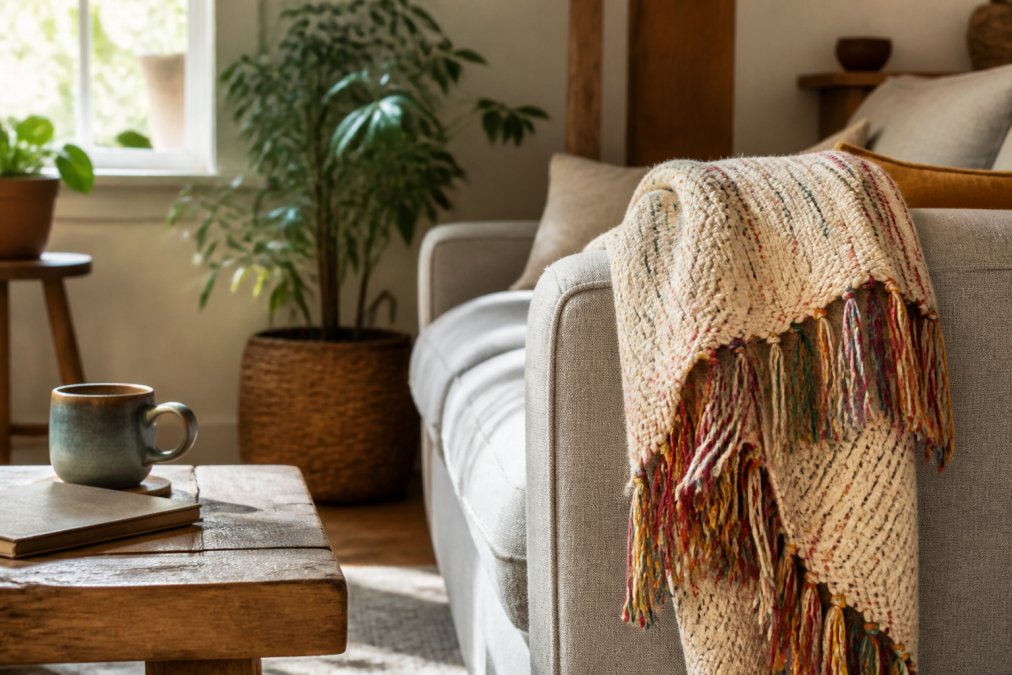
Heirloom woven blankets use 100% cotton yarn on a loom: heavier, more textured, decorative. Fleece blankets use dye sublimation on a plush polyester face for vivid, long-lasting color and a softer hand feel.
| Type | Material | Best For | Care |
|---|---|---|---|
| Heirloom woven | 100% cotton yarn, fringe edge | Display, keepsakes, gifts | Gentle hand wash, air dry |
| Jersey fleece | Knit polyester face, brushed back | Daily use, movie nights | Machine wash cold, tumble low |
| Mink touch fleece | Fleece with metallic sheen | Cozy luxury, gifting | Machine wash cold, tumble low |
| Coral fleece | Fluffy coral fleece | Warmth, larger coverage | Machine wash cold, tumble low |
The Basket Filler's fleece options include the To Mom I Know It's Not Easy - Jersey Fleece Blanket at $47.81 and the Faith Does Not Make Things Easy - Mink Touch Fleece Blanket at $25.74. Both machine wash cold and tumble dry low.
Monogrammed and Engraved Home Goods: What to Expect
Monogrammed and engraved goods are the highest-risk custom category: one wrong letter ruins the piece. The standard is a digital proof showing the exact layout, font, and thread or engraving color before production. If a seller skips that step, you are the quality control, not a job you want.
The Three Monogram Formats (and When Each Works)
Monogram formats:
- Traditional (first-last-middle). The last name initial is centered and larger. This is the default for married couples, family linens, and formal gifts. Example: for Anna Beth Carter, the traditional monogram reads A C B with the C centered and enlarged.
- Initials (first-middle-last). Reads in normal order, all letters the same size. Best for individuals, kids, and anyone who does not want to signal marital status.
- Single initial. One letter, usually the first or last name. This is the safest choice for a gift when you do not know the recipient's middle name or marital preference.
If you cannot confirm the recipient's preference, order a single initial. It is the only format that cannot be wrong.
Font, Thread, and Placement Mechanics
What separates a good monogram from a tacky one is restraint and contrast:
- Font. A clean serif or a simple block letter reads as heirloom. Heavy script fonts with swashes read as novelty and date quickly. For engraved wood or metal, a thin sans-serif holds up better than a script because the engraving bit cannot render fine curves cleanly.
- Thread color. Match the monogram thread to the piece's dominant color, not to the recipient's favorite color. A tonal monogram (cream on cream, navy on navy) looks intentional; a contrasting monogram looks like a team jersey.
- Placement. On a blanket, the monogram typically sits in one corner, roughly 2 to 3 inches from each edge. On a robe or towel, it sits on the chest or cuff. On a cutting board or serving tray, it is centered. Ask the seller where the monogram will land before you approve the proof.
- Size. A monogram should be readable but not dominant. On a throw blanket, a 3- to 4-inch monogram is typical. On a mug or tumbler, 1 to 1.5 inches. If the proof shows a monogram that spans the full width of the piece, ask for it smaller.
Engraving vs. Embroidery vs. Print
The production method changes how the monogram ages:
- Embroidery is stitched thread on fabric. It is durable, has a raised hand, and survives repeated washing. It is the right choice for blankets, robes, and towels.
- Engraving cuts or burns into wood, leather, glass, or metal. It is permanent and does not fade, but it cannot be undone. It is the right choice for cutting boards, tumblers, and keepsake boxes.
- Printing (dye sublimation or digital print) is the least durable option and is best reserved for items that will not be washed often, like a decorative pillow cover or a framed print.
The Two-Minute Conversation That Prevents a $50 Mistake
Confirming the recipient's preference for monogram format and the exact spelling of a name can prevent mistakes and ensure your gift is perfect. A quick conversation and careful review of the proof can save you from a returned gift.
A Quick Pre-Order Checklist
- Confirm the monogram format (traditional, initials, or single initial)
- Confirm the exact spelling of every name, letter by letter
- Confirm the font style and thread or engraving color
- Confirm the placement and approximate size on the finished piece
- Confirm the production window, since monogrammed items often add 2 to 5 business days over the standard lead time
Visualizing Your Custom Piece Before It Ships
Visualizing your custom piece separates a happy order from a return. Every made-to-order purchase should give you three things before production: a digital proof, a close-up photo of the actual fabric, and a clear production timeline.
Here's what to check on the proof:
- Spelling of every name, including middle names and suffixes
- Date format (month/day vs. day/month) matches the recipient's expectation
- Color swatch matches the room or the recipient's palette
- Text placement doesn't crowd the design edges
- Font size is readable at the finished dimensions
A digital proof and a close-up photo of the actual fabric can help you visualize your custom piece before it ships.
Care, Sustainability, and Sourcing Questions to Ask
Care instructions and sourcing are important considerations for custom decor. Knowing where the fiber came from, who made the piece, and how to keep it looking right for a decade helps preserve its beauty.
Fiber-by-Fiber Care (What Actually Preserves the Piece)
Understanding the specific care needs for each custom-decor fiber helps preserve the piece:
- Woven cotton (heirloom blankets, throws). Cold hand wash or a gentle cycle in a mesh bag, then air dry flat. Hot water and machine drying shrink the weave and fray the fringe (cleanipedia.com). If the piece has a hand-knotted fringe, do not put it in a dryer at all.
- Jersey, mink touch, and coral fleece. Cold machine wash, low tumble dry. Avoid fabric softener, which coats the polyester fibers and reduces the plush hand over time. Wash fleece separately from towels to keep lint off the surface.
- Embroidered goods (robes, towels, pillow covers). Turn inside out before washing so the stitching does not snag. Skip bleach entirely, since it weakens both the thread and the base fabric.
- Engraved wood and leather. Wipe with a dry or barely damp cloth. Do not soak. For wood, a light application of food-safe mineral oil once or twice a year keeps the grain from drying and cracking. For leather, a neutral leather conditioner every six months.
- Engraved glass and metal. Hand wash only. Dishwashers etch glass over time and can dull the engraving.
- Printed canvas and framed art. Dust with a dry microfiber cloth. Do not spray cleaner directly on the surface. Keep out of direct sunlight, which fades dye-sublimated prints faster than most people expect.
Sustainability and Ethical Sourcing: The Questions Competitors Do Not Answer
When considering custom decor, it's helpful to understand where the fiber was grown, where the piece was woven or printed, and who did the work. Here are five questions to ask before you buy:
- What is the fiber, and where was it grown or produced? Cotton, polyester, and wool have very different environmental footprints. Organic cotton and recycled polyester are meaningfully different from conventional versions, and a seller who knows their supply chain can tell you which one you are buying.
- Where was the piece manufactured, and where was it assembled? These are not the same thing. A blanket can be woven overseas and finished, fringed, or packaged domestically. Ask which step happens where.
- Who made it? A named production facility, a family-run mill, or a small artisan workshop is a verifiable answer. "Our trusted partners" is not.
- What happens to offcuts and misprints? Made-to-order production generates waste. Sellers who donate, recycle, or repurpose misprints are operating differently from those who do not.
- Is the packaging recyclable or plastic-free? Custom decor is often gifted, and gift packaging is a major source of single-use plastic. Ask whether the box, tissue, and filler are recyclable.
A seller who can answer these five questions often demonstrates a commitment to quality, including showing proofs, stating fiber content plainly, and quoting a realistic production window.
Made-in-the-USA Claims: How to Verify Them
"Made in the USA" is verifiable, but the rules are specific. The Federal Trade Commission requires a product marketed as "Made in USA" to be "all or virtually all" made in the United States: final assembly and processing domestically, with no more than negligible foreign content (the FTC). Claims like "Assembled in USA," "Designed in USA," or "Made in USA from imported materials" are held to a lower standard and must be clearly qualified. If a seller uses an unqualified "Made in USA" claim, asking for the production facility can provide clarity. A seller who designs and assembles domestically but sources fiber overseas should say so plainly, as transparency builds trust.
For the exact disclosure requirements sellers must follow on textile fiber content, country of origin, and care labeling, see the Federal Trade Commission's textile, wool, and care labeling rules.
A Quick Checklist for Evaluating Any Custom Decor Seller
- Do they show a proof before production?
- Do they state fiber content and care instructions plainly, fiber by fiber?
- Do they name where the piece is made, and distinguish manufacturing from assembly?
- Do they answer sourcing questions about fiber origin and production waste?
- Do they offer a satisfaction guarantee in writing?
- Do they quote a realistic production window, not just shipping speed?
Frequently Asked Questions
How do I ensure quality when buying personalized home decor online?
Ask three things before you order: what the item is made from, whether you approve a proof before production, and what the return policy covers on personalized items. For textiles, look for specifics like 100% cotton yarn woven on a loom, or plush polyester fleece with hemmed edges. The Basket Filler's Heirloom Blankets are woven from 100% cotton yarn with colorful fringe, and fleece options use dye sublimation so the print does not peel after washing.
Where can I buy unique personalized housewarming gifts that do not look generic?
Skip the big-box gift aisle and look for made-to-order pieces that tie to the recipient's story. A woven keepsake blanket with a family name, a wedding date, or an inside joke works because it is not something they could pick up at a store. The Basket Filler offers options like the Adventure Awaits Woven Blanket at $44.13 or the Til Death Do Us Part Heirloom Blanket at $44.13, both woven from 100% cotton yarn and packaged for gifting.
What should I look for in a custom home decor retailer?
Check four things: whether they show real product photos instead of only mockups, whether they confirm spelling and dates before production, how fast they ship made-to-order items, and whether they stand behind a satisfaction guarantee. Ask directly how they handle a misspelled name or wrong date, since that is the most common complaint with personalized orders.
How long does custom home decor take to arrive?
Made-to-order pieces usually need production time before shipping, so plan on ordering at least two to three weeks ahead of a birthday or holiday. Woven blankets, printed fleece, and engraved items all go through a production step that cannot be rushed without cutting quality. If you are working against a deadline, confirm the production window in writing before you pay, and choose a retailer that offers express delivery on in-stock designs.
Are there benefits to buying custom home decor from small businesses?
Small businesses often provide a personal touch to personalization, with a real person checking your spelling and layout. They also tend to source and assemble domestically, offering transparency about material origins. While prices may be higher than mass-market options, you are investing in a thoughtfully crafted piece designed to last.
Custom home decor orders fail for predictable reasons: no proof, vague materials, and unrealistic timelines. The Basket Filler removes all three by showing you the design before production, using 100% cotton yarn and clearly specified fleece, and backing every order with a 100% customer satisfaction guarantee and fast shipping. If you're ready to buy custom home decor online that actually gets kept, browse the heirloom and fleece blanket collection and start your order today.


