


Table of Contents
- Why a Quality Check Matters Before You Gift an Engraved Watch
- What You'll Need for a Proper Inspection
- Step 1: Inspect Engraving Depth, Clarity, and Alignment
- Step 2: Check Caseback Sealing and Water Resistance
- Step 3: Verify Material Integrity and Surface Finish
- Laser vs Mechanical Engraving: How Each Method Affects Quality Checks
- How to Choose a Watch for Engraving
- Custom Watch Engraving Cost: What You're Paying For
- Frequently Asked Questions
Last Updated: September 24, 2026
Why a Quality Check Matters Before You Gift an Engraved Watch
A quality check for custom engraved watches is the step that separates a keepsake from a regret. A quality check for custom engraved watches is the step that separates a keepsake from a regret.
What You'll Need for a Proper Inspection
Gather these before you start:
- A bright desk lamp or phone flashlight
- A jeweler's loupe or a magnifying app
- A soft microfiber cloth
- A small bowl of water (for the seal test)
- Good overhead lighting
Set everything on a clean, well-lit surface. Good light is half the battle.
Step 1: Inspect Engraving Depth, Clarity, and Alignment
Start with the most visible issue: how the letters actually look. A clean engraving has even depth, sharp edges, and letters that sit straight.
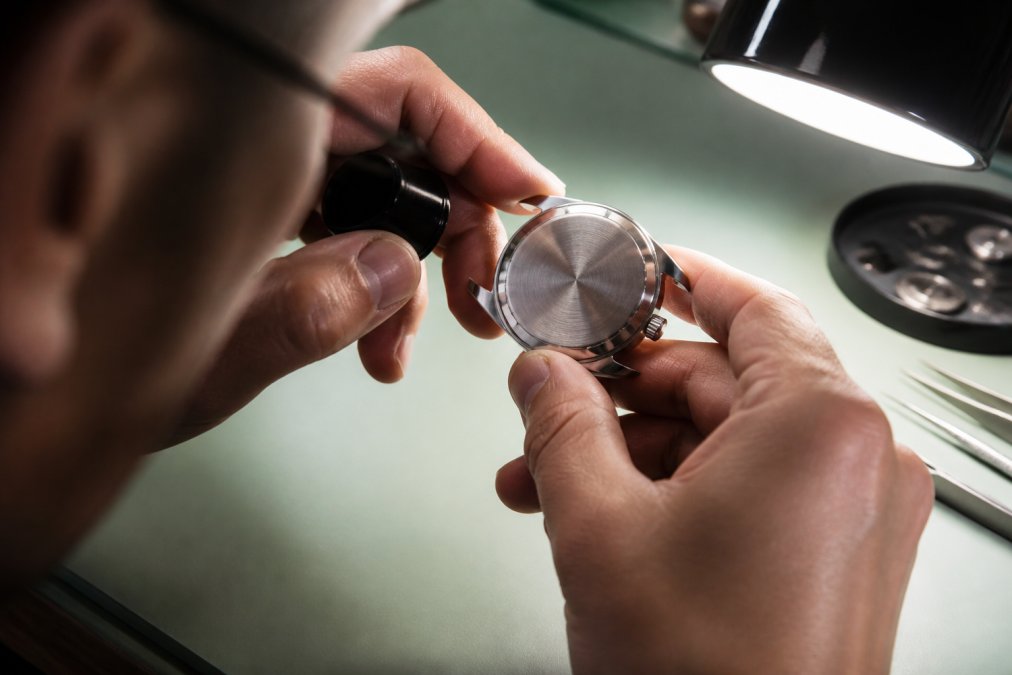
Reading Depth Under Angled Light
Angled light casts tiny shadows inside each cut. Even shadows mean even depth. If some letters look shallow and others look deep, the engraver rushed the pass.
Checking Character Spacing and Font Consistency
Look at the gaps between letters and words. They should match from start to finish. A name that starts tight and ends loose means the machine drifted or the hand wobbled.
Step 2: Check Caseback Sealing and Water Resistance
This step is the one most buyers skip, and it's the one that matters most. Engraving near the caseback edge can damage the gasket that seals out water, and once that seal fails, a watch rated for water resistance can become vulnerable to splashes.
How the Seal Actually Works
A screw-down caseback seals against the case with a gasket seated in a groove. The gasket compresses when the caseback is torqued to spec. Engraving that cuts into the gasket groove, distorts the caseback lip, or removes enough metal to change the caseback's flatness can break that compression, even if the engraving looks perfect.
Common gasket materials you'll encounter:
- Nitrile (Buna-N): standard on most stainless steel watches, good for 100-200 m ratings
- Silicone: better temperature range, common on dive watches
- Viton (FKM): chemical resistant, found on higher-end pieces
- Teflon-encapsulated: rare, used on some titanium cases
The Five-Point Seal Inspection
- Gasket groove: Look for cuts, pinches, or displaced rubber where the caseback meets the case. Engraving tools that slipped can nick the groove.
- Caseback flatness: Place the watch on a flat surface and press one edge. Any rocking means the caseback warped, a common result of laser heat or heavy mechanical engraving.
- Engraving-to-seal distance: The engraving should sit at least 2-3 mm inside the gasket groove. Closer than that and the metal between the cut and the seal is too thin.
- Thread condition: On screw-down backs, check the threads for cross-threading or debris. A caseback that doesn't seat by hand is a red flag.
- Crown and pushers: Engraving heat or ultrasonic cleaning can dry out crown gaskets. Check that the crown screws down smoothly.
The Water Drop Test (and Its Limits)
Place a few drops of room-temperature water on the caseback and wait one minute. Wipe dry. Any moisture seeping inside is a fail. This test catches gross seal failures but will not detect a slow leak under pressure.
When to Get a Pressure Test
A watchmaker's pressure test uses a dry air chamber or a wet tank to verify the seal at rated depth. Typical turnaround is same-day at a local jeweler. Ask for the test result in writing, most shops log the pass/fail pressure and the date.
What Voids the Rating
Aftermarket engraving that touches the caseback can be considered a modification. If the watch is under warranty, it's advisable to confirm with the manufacturer before engraving.
Step 3: Verify Material Integrity and Surface Finish
Good engraving respects the metal it cuts. Bad engraving leaves burrs, cracks, or a dull patch around the letters. What counts as "good" depends on the metal.
How Each Metal Behaves Under the Tool
Stainless steel (316L, 304): The most forgiving caseback metal. Laser engraving produces a clean, shallow mark with minimal heat-affected zone. Diamond drag cuts a bright, consistent line. Watch for: slight discoloration on 304 grades, which have less corrosion resistance than 316L.
The Material-Specific Defect Checklist
| Metal | Most Common Defect | What It Looks Like | Fixable? |
|---|---|---|---|
| Stainless 316L | Minor discoloration | Faint brown tint at cut edge | Usually polishable |
| Titanium Grade 2 | Smearing / burrs | Rough, gummy edges | Sometimes re-cut |
| Titanium Grade 5 | Oxidation halo | White-gray ring around cut | Often permanent |
| 14k-18k gold | Burring | Raised lip around letters | Usually polishable |
| 24k gold | Smearing | Distorted, soft letterforms | Rarely fixable |
| Sterling silver | Tarnish in cut | Dark line inside letters | Cleanable, recurs |
| PVD / DLC coated | Base metal exposure | Color mismatch in cut | Not fixable |
Why the Method Matters More Than the Metal
Laser engraving concentrates heat in a tiny spot. Diamond drag cuts mechanically, no heat, but it can chip brittle coatings and work-harden some materials.
The Fingernail and Light Test
Run a fingertip over the surface. It should feel smooth, not gritty. Then tilt the watch under a desk lamp so light rakes across the engraving at a low angle. Even shadows inside the cuts mean even depth. A halo, a color shift, or a rough edge means the material was pushed past its limit.
Laser vs Mechanical Engraving: How Each Method Affects Quality Checks
The engraving method changes what you inspect. Laser engraving uses a focused beam to vaporize metal, leaving a precise, shallow mark. Mechanical engraving, whether diamond drag or hand engraving, cuts deeper into the surface.
| Method | Depth | Best For | What to Check |
|---|---|---|---|
| Laser | Shallow, precise | Fine detail, logos | Burn marks, clarity |
| Diamond drag | Medium | Simple text, curves | Line consistency |
| Hand engraving | Deep, varied | Artwork, script | Tool marks, depth |
How to Choose a Watch for Engraving
Not every watch takes engraving well. The caseback material and thickness decide how clean the final result will be.
Ask yourself:
- Is the caseback flat enough for clean text?
- Is the metal thick enough to cut without risk?
- Will the engraving sit clear of the seal?
Custom Watch Engraving Cost: What You're Paying For
Custom watch engraving cost depends on the method, the material, and how much text you want.
Here's what drives the price:
- Method: laser is cheaper, hand engraving is pricier
- Material: soft metals cost more to work with
- Text length: more characters, more time
- Detail level: artwork and script cost more than block text
Frequently Asked Questions
How much should custom watch engraving cost?
Custom watch engraving cost depends on the method, the material, and the number of characters. Laser engraving typically runs $15 to $50 for a simple caseback inscription. Hand engraving by a skilled artisan starts around $50 and can exceed $150 for detailed work. If you're buying a watch that already includes engraving, like the My Husband My Love Black Chronograph Watch at $66.17, the customization is often built into the price. Always ask what's included before you order.
Does engraving affect the water resistance of a watch?
Engraving can compromise water resistance if it penetrates too deep or disturbs the caseback gasket. A quality check for custom engraved watches should include verifying that the caseback still seats flush and the gasket is undamaged. Shallow laser engraving on the exterior of a caseback usually leaves the seal intact. Deep mechanical engraving near the edge or on the gasket channel is riskier. If your watch is rated 3ATM or higher, test it gently with a few water drops before wearing it in a pool or shower.
What are the common mistakes to avoid when engraving a watch?
The biggest mistakes are choosing a font too small to read, engraving on a curved surface without proper alignment, and skipping a proof before the final cut. Always request a digital mockup of your inscription. Check that dates, names, and spelling are correct. Avoid engraving over the gasket or too close to the case edge. If you're working with a wooden watch like the Dad's Love Wooden Watch, know that sandalwood can chip if the engraving depth is too aggressive.
Does engraving affect the resale value of a watch?
Engraving almost always lowers resale value for luxury or collectible timepieces because it personalizes the piece. A buyer looking for a vintage Rolex does not want someone else's anniversary date on the caseback. For affordable gift watches under $100, resale value is rarely a concern. The engraving is the point. If you're buying a watch specifically as an investment, skip the engraving. If you're buying it as a sentimental gift, the personalization is worth more than any future resale.
A custom engraving can become a family heirloom, or a source of quiet disappointment. The difference comes down to a careful quality check before you gift it. The Basket Filler designs and assembles most products in the USA, backs every order with a 100% customer satisfaction guarantee, and ships fast so your gift arrives on time. Explore our bespoke watches and personalized gifts, and give something built to be treasured.


