


Table of Contents
- Why Custom Gifts Take Longer Than Store-Bought Items
-
The Step-by-Step Production Cycle Behind Every Custom Gift
- Stage 1: Design Proofing, Where Errors Get Caught Before They Cost You
- Stage 2: Material Sourcing, Why Small-Batch Isn't the Same as In-Stock
- Stage 3: Crafting, The Stage That Actually Determines Your Timeline
- Stage 4: Quality Assurance, The Inspection Mass Production Skips
- Stage 5: Fulfillment and Shipping
- What Personalized Gift Production Time Really Looks Like
- The Benefits of Handmade Gifts That Justify the Wait
- Unique Wedding Gift Ideas Made USA: Why They Take Extra Time
- How to Plan Your Custom Gift Order Without the Stress
- Frequently Asked Questions
Last Updated: September 27, 2026
Why Custom Gifts Take Longer Than Store-Bought Items
When you order a personalized gift, the wait isn't a flaw in the process. It's the process. Custom gifts take longer because each item is made for one specific person, not pulled from a warehouse shelf. This guide from The Basket Filler explains what happens between your order and your doorstep.
A store-bought item was manufactured months ago in bulk and stocked on a shelf. A custom gift skips all of that: nothing exists until you place the order. The production clock starts the moment your details enter the system, and every stage after depends on human hands rather than a conveyor belt.

Below, we break down each stage of the production cycle and how to plan around it. Most guides treat the wait as a customer service failure when it's actually a quality signal.
The Step-by-Step Production Cycle Behind Every Custom Gift
Every custom gift moves through four stages: design proofing, material sourcing, crafting, and quality assurance before fulfillment. Skipping or rushing any one is exactly how personalized items end up with misspelled names or mismatched dates.
Stage 1: Design Proofing, Where Errors Get Caught Before They Cost You
Design proofing is where your text, spelling, font, and layout get checked before anything physical happens. A common mistake is assuming the seller will catch problems. Reputable makers do review orders, but proofing works best when both sides verify the details.
What actually happens during proofing is a sequence, not a single check:
- Order intake. Your personalization details are transcribed into the production queue. A typo gets locked in unless someone flags it.
- Typesetting or layout. The maker sets your text in the chosen font, sizes it to the item, and checks spacing. Multi-word names, apostrophes, and accented characters take longer because they don't always fit standard templates.
- Proof review. Either the maker sends you a digital proof to approve, or an internal reviewer signs off. Orders requiring customer approval sit idle until you respond, a common, invisible delay.
- Queue placement. Once approved, the order moves to the production schedule. If ten orders were approved ahead of yours, yours waits its turn.
Proofing isn't slow because the maker is slow; it's slow because approval is a two-party handshake, and the queue is first-come, first-served.
Stage 2: Material Sourcing, Why Small-Batch Isn't the Same as In-Stock
Material sourcing follows proofing. Small-batch creators work with limited stock of specific finishes, chains, or fabrics, so each order gets matched to available materials rather than infinite inventory.
The difference from mass retail is structural. A big-box manufacturer buys 100,000 units of a single chain style and stores them in a distribution center. A small-batch maker might keep 20 on hand, order more from a domestic supplier when stock runs low, and wait several days for restock. If your finish is out of stock, the maker can substitute (with your approval), wait for restock, or refund. None of those is instant.
Domestic production adds a specific kind of time. Sourcing from U.S. suppliers keeps quality verifiable and avoids overseas transit delays, but it means depending on a smaller supplier network without same-day availability.
Stage 3: Crafting, The Stage That Actually Determines Your Timeline
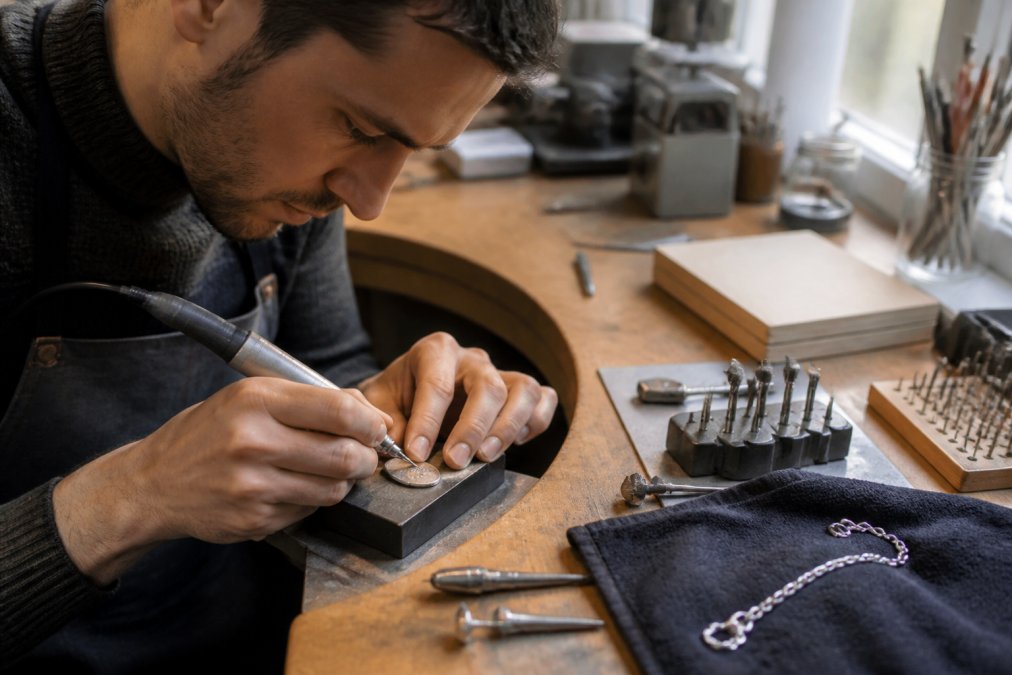
Crafting is where the piece takes shape, and it's the stage most responsible for turnaround time. Hand-crafted work doesn't scale like machine production. One artisan working on one necklace cannot match a factory line, and that's the point.
What makes crafting slow isn't just manual labor, it's the setup cost per unit. A factory line stamps 500 identical pendants by loading one die. A custom maker resets the engraving tool, repositions the workpiece, and re-verifies alignment for every order. Setup time is roughly constant regardless of design complexity, which is why a one-word engraving and a five-word engraving often take similar amounts of time.
Hand-finishing adds another layer. Polishing, soldering, edge-smoothing, and clasp attachment are done by hand on most small-batch pieces, each at a pace that can't be compressed without sacrificing the finish quality that justifies the custom price.
Stage 4: Quality Assurance, The Inspection Mass Production Skips
Quality assurance comes next. Each finished item is inspected for finish quality, clasp function, engraving accuracy, and construction before shipping.
This stage most clearly separates custom from mass-produced.
Stage 5: Fulfillment and Shipping
Order fulfillment wraps the piece, packages it, and hands it to the carrier. Packaging matters more for custom items because the item is often a gift and presentation is part of the value. Gift boxing, tissue, ribbon, and insert cards are each a manual step.
What Personalized Gift Production Time Really Looks Like
Personalized gift production time depends on the item type, the complexity of the customization, and how many orders are ahead of yours. Simpler single-line engravings move faster than multi-element designs. Peak seasons like December and early May stretch every stage, because small shops handle a surge with the same number of hands.
| Stage | What Happens | Typical Duration |
|---|---|---|
| Design proofing | Text, spelling, and layout verified | A few hours to 1 day |
| Material sourcing | Components matched to the order | 1-2 days |
| Crafting | Hand assembly or engraving | 2-5 days |
| Quality assurance | Inspection for finish and accuracy | Same day to 1 day |
| Fulfillment and shipping | Packing and carrier transit | 2-5 days |
The Benefits of Handmade Gifts That Justify the Wait
The benefits of handmade gifts come down to what the extra time buys: attention, durability, and emotional weight mass-produced items can't replicate. A machine-stamped item and a hand-finished one may look similar in a photo, but they don't feel the same in hand.
Unique Wedding Gift Ideas Made USA: Why They Take Extra Time
Multiple personalization elements. A standard custom gift might carry one variable: a single name, date, or initial. A wedding gift often carries three or four at once, two names, a wedding date, sometimes a venue or short phrase. Each element is a separate proofing decision and a chance for a mismatch that must be caught before crafting.
A Lead-Time Calendar for Wedding Season
If you're ordering a custom wedding gift, work backward from the wedding date, not forward from today. A practical buffer looks like this:
| Time Before Wedding | Action |
|---|---|
| 8+ weeks | Research makers, confirm personalization details with the couple (exact spellings, date format) |
| 6 weeks | Place the order; allow time for a proof to come back |
| 5 weeks | Approve the proof within 24 hours of receiving it |
| 3-4 weeks | Production and quality assurance window |
| 2 weeks | Shipping buffer, especially for peak season |
How to Plan Your Custom Gift Order Without the Stress
Planning around production time is simpler once you know the stages. Work backward from the date you need the gift in hand, then add a buffer for the unexpected.
- Confirm the exact name, spelling, and date before ordering
- Note the maker's stated production window, not just shipping speed
- Order at least two to three weeks before the occasion during normal seasons
- Add an extra week for December, May, and other peak gifting periods
- Request a proof or confirmation if the maker offers one
- Save your order confirmation with all personalization details
Frequently Asked Questions
Why do personalized gifts have longer processing times than mass-produced items?
Mass-produced items are made in bulk on automated assembly lines, while custom gifts are made one at a time after you order. Each piece goes through design proofing, material sourcing, hand-crafting, and quality assurance before it ships. The Classic Style Name Necklace from The Basket Filler, for example, is custom made upon ordering with up to 10 characters, so production cannot start until your order is confirmed.
How far in advance should I order a personalized gift for a special occasion?
Plan for at least two to three weeks before the date you need it. That covers the design proofing stage, the production cycle, and shipping time. For holidays like Christmas or Valentine's Day, add another week because small-batch creators face higher order volumes. If your deadline is tight, contact the seller directly to confirm their current turnaround time before you buy.
Are custom-made gifts higher quality than store-bought alternatives?
Custom gifts often go through more hands-on quality checks because each item is made individually. A hand-crafted necklace like the Signature Style Name Necklace is inspected for engraving accuracy and finish before it ships, something that does not happen with mass-produced items. The craftsmanship and personalized keepsake value are part of what you pay for, along with the sentimental worth of a one-of-a-kind gift.
What happens if my custom gift arrives with a mistake or I am not satisfied?
Reputable custom gift sellers offer a satisfaction guarantee. The Basket Filler backs every order with a 100% customer satisfaction guarantee. If a personalized item arrives with a spelling error or does not meet your expectations, reach out to the seller right away with photos. Most small-batch creators will remake or refund the item, but you need to report the issue within their stated window.


