


Table of Contents
- What You'll Need to Assess Jewelry Quality
- How to Identify Jewelry Hallmarks and Purity Stamps
- Fine Jewelry vs Costume Jewelry Differences: A Quick Comparison
- Signs of High-Quality Gemstone Settings
- Evaluating Craftsmanship and Metal Quality
- DIY Home Testing Kits and Digital Verification
- The Role of Professional Appraisals and Ethical Sourcing
- Frequently Asked Questions
Last Updated: September 28, 2026
What You'll Need to Assess Jewelry Quality
Learning how to assess jewelry quality starts with knowing what to look for before you ever bring a loupe to a stone. This guide from The Basket Filler walks through the exact steps appraisers, jewelers, and experienced buyers use to separate genuine craftsmanship from clever marketing, whether you are evaluating a family heirloom or a new gift.
How to Identify Jewelry Hallmarks and Purity Stamps
A hallmark is a stamped mark indicating the metal's purity, origin, or maker, and it is the fastest way to identify jewelry hallmarks on any piece. In the United States, purity is typically expressed in karats for gold or parts per thousand for silver and platinum.
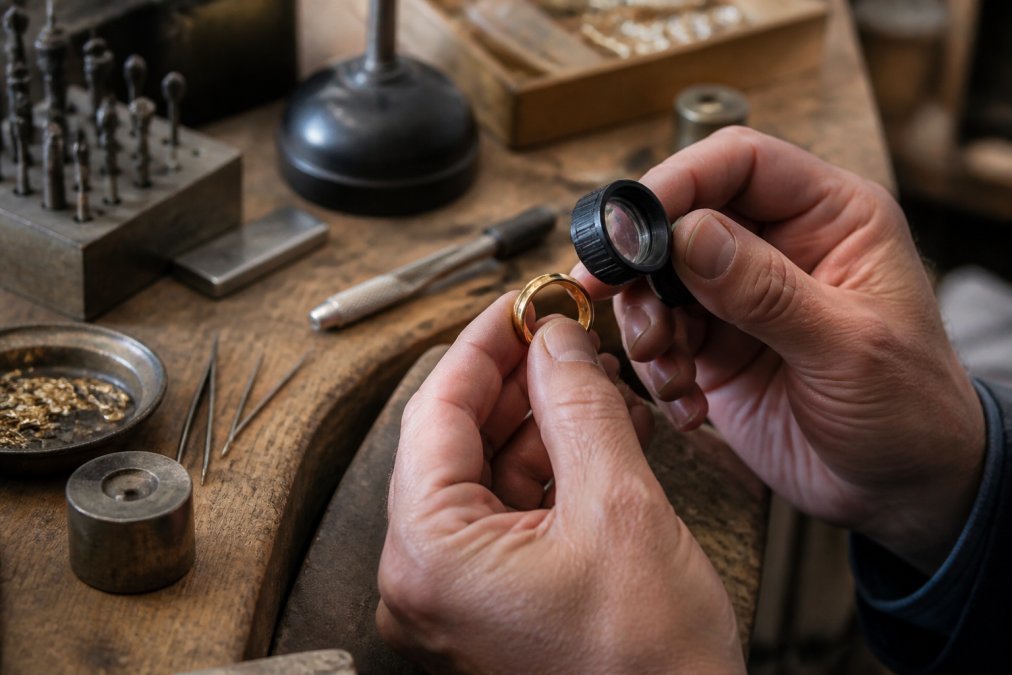
Common Hallmark Symbols and What They Mean
- 10K, 14K, 18K, 24K: gold purity by karat. 24K is pure gold; 14K is roughly 58% gold.
- 925 or "Sterling": sterling silver, 92.5% silver.
- PLAT, 950, 900: platinum, measured in parts per thousand.
- Maker's mark: a stamp identifying the manufacturer or assay office.
A missing hallmark is not proof of a fake, but it does mean you should verify the metal another way before paying a fine-jewelry price.
Fine Jewelry vs Costume Jewelry Differences: A Quick Comparison
The clearest difference between fine jewelry and costume jewelry comes down to materials and construction. Fine pieces use solid precious metals and genuine gemstones; costume pieces use base metals with plating and simulated stones.
| Feature | Fine Jewelry | Costume Jewelry |
|---|---|---|
| Base metal | Gold, platinum, sterling silver | Brass, copper, alloy |
| Gemstones | Natural or lab-grown | Glass, plastic, cubic zirconia |
| Construction | Soldered, hand-set | Glued, prong-stamped |
| Hallmark | Present | Usually absent |
| Resale value | Holds market value | Minimal |
Materials, Construction, and Value
Plating is the giveaway. Gold plating wears through at contact points, usually within months on a ring, while solid gold shows wear as gradual surface patina rather than flaking. Turn a piece over and inspect the clasp, jump rings, and any solder joints. Fine jewelry construction is finished on the underside too.
Signs of High-Quality Gemstone Settings
High-quality gemstone settings hold the stone securely without hiding flaws or risking loss. Look for even prongs, a flush seat, and no visible gaps between the stone and the metal.
Check these four things:
- Prong count and symmetry: four or six prongs, evenly spaced and matching in size.
- Setting integrity: no wobble when you gently press the stone with a soft tool.
- Stone seating: the girdle sits level, not tilted.
- Bezel or channel edges: smooth and continuous, with no burrs.
Evaluating Craftsmanship and Metal Quality
Craftsmanship shows in the parts a seller hopes you will not inspect. Run your fingertip along the inside of a band, the back of a pendant, and the underside of a clasp. Rough edges, uneven solder, and visible porosity all point to rushed production.
DIY Home Testing Kits and Digital Verification
Most guides stop at theory. This section is the practical one: what you can actually test at home, what each tool can and cannot tell you, and how to verify quality when the piece is only ever shown to you through a screen.
Home Testing Tools: What Each One Actually Does
| Tool | Typical Cost | What It Confirms | What It Cannot Do |
|---|---|---|---|
| 10x jeweler's loupe | $10-$30 | Hallmark crispness, prong symmetry, stone inclusions | Grade a stone or confirm karat |
| Rare-earth magnet | $5-$15 | Flags ferromagnetic base metals under plating | Detect non-magnetic fakes like tungsten or brass |
| Gemstone thermal tester | $100-$250 | Separates diamond from most simulants (CZ, glass) | Distinguish natural from lab-grown diamond |
| Electronic gold tester | $150-$400 | Surface karat reading on gold | Read through plating or verify internal composition |
| Acid test kit | $20-$50 | Karat range on an exposed scratch | Non-destructive use, it always mars the metal |
| Digital scale (0.01 g) | $15-$40 | Weight vs. expected density for a given size and karat | Identify metal on its own |
A common pattern: a piece passes the magnet test, passes the thermal tester, and still turns out to be gold-plated brass with a moissanite. Each tool answers one narrow question. None of them certifies quality.
A 5-Minute Home Inspection Sequence
- Loupe the hallmark. Crisp, struck edges suggest a genuine stamp; shallow or raised lettering suggests laser etching over plating.
- Weigh and compare. A 14K yellow gold band in a standard size typically falls in a predictable weight range for its width. A piece that feels dramatically light for its size is often hollow or plated.
- Magnet sweep. A strong pull toward a rare-earth magnet is a red flag for a ferrous core.
- Thermal test the main stone. A diamond tester will separate diamond from CZ and glass, but it will read lab-grown and natural diamond the same way.
- Wiggle test the setting. Gentle pressure with a soft tool should produce zero movement. Any wobble means a reset is in your near future.
Verifying Quality on an Online Purchase
Online shopping removes the loupe from your hand, so the verification shifts to documentation and the seller's willingness to be specific.
Ask for, and expect to receive:
- A lab report number you can look up independently. Reputable labs such as the Gemological Institute of America (GIA) and the American Gem Society Laboratories host public report-verification tools. Never verify through a link the seller sends, type the lab's domain yourself.
- Macro photos of the hallmark and any girdle inscription. A laser-inscribed report number on the girdle should match the paper report exactly.
- A live video call under magnification. Ask the seller to zoom on the prongs, the clasp, and the hallmark. A seller who resists a video call is telling you something.
- A written spec sheet. Metal, karat, stone type, carat weight, and measurements, not marketing names like "genuine diamond alternative."
The Role of Professional Appraisals and Ethical Sourcing
A professional appraisal is the only way to establish replacement value for insurance or resale. It is also the step most buyers skip because they do not know what a good one looks like.
What a Real Appraisal Includes
A qualified appraiser examines the piece in person and issues a written report that documents:
- Metal type and karat, verified, not just read off the stamp
- Gemstone identity, carat weight, and measured dimensions
- A grading opinion on color and clarity for the primary stones
- Setting and construction description
- Photographs of the piece and any identifying marks
- The intended use of the report (insurance replacement vs. fair market value vs. liquidation)
Credentials to Look For
Appraisal credentials in the trade include the American Society of Appraisers (ASA) and the International Gemological Institute (IGI) for gemological training. Membership in a professional appraisal association is not a guarantee of accuracy, but it does signal that the appraiser has agreed to a code of ethics and continuing education requirements.
Ask two questions before you book:
- What credentials do you hold, and in what specialty? A jewelry appraiser should hold gemological or appraisal-specific credentials, not general personal-property credentials alone.
- Is your fee flat or tied to the appraised value? Flat fees avoid the conflict of interest that comes with value-based pricing.
Ethical Sourcing: The Questions That Actually Get Answers
Sourcing is the newer half of the quality question, and it is the one most guides skip. Quality is not only what a piece is made of, it is also how the material got to you.
Ask sellers these specific questions:
- For diamonds: "Can you provide the Kimberley Process certificate or a written conflict-free sourcing statement?"
- For colored stones: "Which country and, if known, which mine did this stone come from?" Traceability for sapphires, rubies, and emeralds is far less standardized than for diamonds, so a seller who can name the origin is ahead of the curve.
- For gold: "Is this recycled gold, Fairmined, or conventionally mined?" Recycled gold is chemically identical to newly mined gold and avoids new extraction.
- For the brand overall: "Do you publish a sourcing or sustainability statement?" A public statement is verifiable; a verbal assurance is not.
Frequently Asked Questions
How can you tell if jewelry is high quality?
Check for hallmarks or purity stamps, such as 14K or 925, which indicate metal content. Examine gemstone settings for secure prongs and smooth finish. Look for even color and clarity in stones. High-quality pieces feel solid, have no rough edges, and often come with certification or appraisal documentation. If you're unsure, a professional jeweler can confirm authenticity and craftsmanship.
What are the hallmarks of quality jewelry?
Quality jewelry typically carries a hallmark or purity stamp inside the band or clasp. Common marks include 14K, 18K, 925 for sterling silver, and PLAT for platinum. These stamps show the metal's purity in parts per thousand. Also look for clean solder joints, secure stone settings, and a smooth, polished finish. A maker's mark or country of origin stamp adds another layer of assurance.
How do I know if my jewelry is real gold or silver?
Start by looking for a hallmark: 10K, 14K, 18K for gold, or 925 for sterling silver. Real gold won't tarnish easily and feels dense for its size. Silver may tarnish but polishes back to a bright shine. You can also use a home testing kit or visit a jeweler for non-destructive testing. If the piece is magnetic, it's likely not real gold or silver.
Should I get my jewelry appraised to determine its quality?
Yes, a professional appraisal confirms metal purity, gemstone identity, and overall condition. Appraisals provide a documented value for insurance or resale. Choose a credentialed appraiser who uses gemological standards and provides a written report. While not required for everyday pieces, an appraisal is smart for valuable or inherited jewelry. It also helps you understand replacement value versus market value.
Buying jewelry you cannot fully inspect in person is the real challenge, and it is where most online shoppers get burned. The Basket Filler designs and assembles most products in the USA, backs every order with a 100% customer satisfaction guarantee, and ships fast so a personalized piece arrives in time for the occasion. Shop Now and give a gift that holds up to inspection.


