


Table of Contents
- The Psychology Behind Why Personalized Gifts Are Thoughtful
- Benefits of Personalized Gifts: Emotional Connection and Perceived Value
- Impact of Custom Gifts on Relationships: Building Stronger Bonds
- Personalized Gift Ideas for Grandparents: Thoughtful Keepsakes They'll Treasure
- The Neuroscience of Gift-Giving: Why the Brain Responds to Personalization
- Sustainability and Cultural Nuances in Personalized Gifting
- Frequently Asked Questions
Last Updated: September 29, 2026
The Psychology Behind Why Personalized Gifts Are Thoughtful
A personalized gift works because it proves the giver paid attention. That sounds simple, but it is the entire mechanism. Research from the American Psychological Association on social connection consistently shows that feeling known and valued by others is a core driver of wellbeing, and a custom gift delivers that feeling in physical form. This guide from The Basket Filler breaks down the gift-giving psychology behind meaningful gifts, from effort signals to perceived value, and shows you how to choose keepsakes people actually treasure.
How Customization Signals Effort and Attention
Customization is an effort signal. When someone orders a name necklace with a specific spelling, they had to know the person's name, remember it, and plan ahead. The recipient reads that effort instantly, and the brain treats it as evidence of care. A store-bought item says "I thought of you." A bespoke item says "I thought about you specifically."

The Gift-Giver's Paradox: Why Effort Outweighs Price
The Gift-Giver's Paradox is the gap between what givers think recipients want and what recipients actually value. Givers reach for price tags; recipients reach for meaning. A common mistake is assuming a more expensive item reads as more thoughtful. In practice, a tailored gift that references a shared memory or a personal detail outperforms a pricier generic one almost every time.
Benefits of Personalized Gifts: Emotional Connection and Perceived Value
The benefits of personalized gifts come down to two things: emotional connection and perceived value. A custom item carries sentimental value a mass-produced one cannot, because it cannot be swapped or replaced with an identical copy. That uniqueness raises how much the recipient values it, and it makes the gift feel like a relationship statement rather than an obligation.
Consider what a custom piece actually communicates:
- It says the giver knows the recipient's taste, not just their size
- It signals that time and thought went into the choice
- It creates a one-of-a-kind object with no duplicate on a shelf
- It turns a routine occasion into a meaningful interaction
Impact of Custom Gifts on Relationships: Building Stronger Bonds
The impact of custom gifts on relationships shows up in everyday moments, not just the moment of unwrapping. A personalized keepsake stays in view: on a nightstand, around a neck, on a wall. Each time the recipient sees it, the relationship gets a small reinforcement. That is relationship maintenance in its most practical form.
The Gift-Giver's Paradox, Revisited
Earlier we noted that givers reach for price tags while recipients reach for meaning. The relationship effect runs in both directions. Givers who choose a personalized item report more satisfaction with the exchange than givers who buy something generic at a higher price, because the act of personalizing forces them to think about the recipient as a specific person rather than a category. That thinking is the gift.
From Gratitude to Lasting Memories
Gratitude fades fast. Memories do not. A custom gift works as a memory anchor, tying an object to a specific person, day, and feeling. Many recipients report that the story behind a personalized item matters as much as the item itself, which is why a handcrafted piece from a small maker often lands harder than a generic luxury good. The gift becomes a lasting impression because it is inseparable from the person who gave it.
Concrete examples of how this plays out:
- A necklace engraved with a wedding date becomes the thing a spouse touches when they think about the marriage, not just an accessory.
- A cutting board with a family recipe burned into it turns a weekly cooking routine into a recurring reminder of the person who passed the recipe down.
- A framed map marked with the coordinates of a first apartment turns a wall decoration into a conversation piece that retells the story every time a guest asks about it.
Personalized Gift Ideas for Grandparents: Thoughtful Keepsakes They'll Treasure
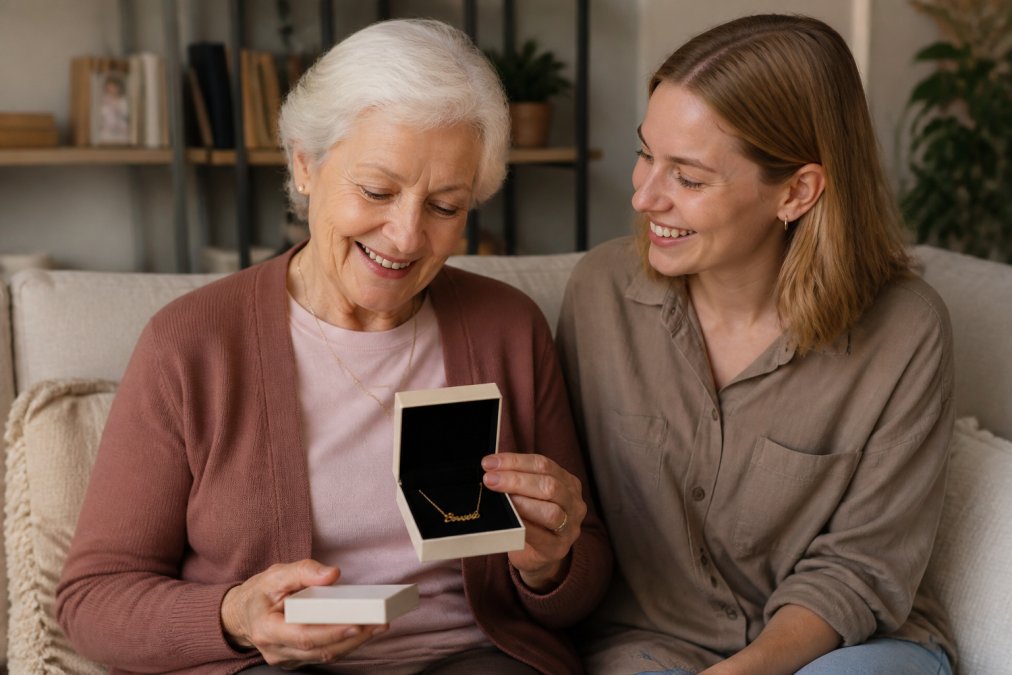
The best personalized gift ideas for grandparents lean on names, dates, and family connection. Grandparents are often the easiest people to shop for and the hardest to impress, because they tend to value sentiment over novelty. A keepsake that names a grandchild, marks an anniversary, or honors a family milestone tends to outperform anything trendy.
A Framework for Choosing the Right Detail
Most guides list gift ideas. Fewer explain how to pick the personalization itself, which is where the gift either lands or misses. Three questions sort almost every case:
- What name or date do they say out loud most often? A grandparent who talks about a specific grandchild daily will wear that name. A grandparent who talks about the family as a whole may prefer a surname or a family-established date.
- What format do they already use? If they wear jewelry every day, a name necklace fits into an existing habit. If they never wear jewelry, a personalized item that lives in the kitchen, the garden, or on a wall will get more use.
- What is the occasion? A milestone anniversary calls for a date. A new grandchild calls for a name. A 'just because' gift calls for a shared memory or inside reference.
Options That Consistently Work
- A name necklace featuring a grandchild's name, worn close to the heart
- A piece that marks a milestone anniversary or a birth year
- A custom keepsake for a grandparent who has everything and wants nothing
- A personalized item tied to a shared routine, such as a recipe, a garden, or a weekly card game
The Classic Style Name Necklace from The Basket Filler is a strong fit here. It is custom made to order with up to 10 characters, available in polished stainless steel or 18K yellow gold finish, and it arrives in a complimentary soft touch box with an optional mahogany-style box upgrade. For grandparents who wear jewelry daily, the Signature Style Name Necklace offers a more contemporary font, and the Classic Vertical Name Necklace suits someone who prefers a cleaner silhouette.

The Cultural and Family Nuance Most Guides Skip
What counts as the 'right' personal detail varies by family and by cultural background. In some families, a first name is the most meaningful marker. In others, a family surname, a religious name, or a name in a heritage language carries more weight than an English-language nickname. For grandparents who immigrated or who maintain close ties to a heritage culture, personalizing in the language or script the family uses at home often lands harder than an English equivalent.
Why Personalization Also Reduces Waste
A bespoke item made to order tends to be kept longer than a mass-produced one, which means fewer replacements and less waste over time. For grandparents in particular, a personalized keepsake often becomes a hand-down item rather than a discard, which is the opposite of the disposable-gift pattern. Choosing a maker that produces domestically also shortens the supply chain, a factor many gift-givers now weigh alongside price.
For grandparents, the name on the piece matters more than the metal. Choose the name they say most often, and you have chosen correctly.
Personalizing the wrong detail is worse than personalizing nothing. A gift engraved with a name the recipient never uses, or a date they would rather forget, reads as a miss rather than a gesture.
The Neuroscience of Gift-Giving: Why the Brain Responds to Personalization
The neuroscience of gift-giving explains why personalization lands so hard. Receiving a gift activates the brain's reward circuitry, and anticipation plays a large role in that response. When a gift is clearly tailored, the recipient's brain treats it as a social signal rather than a transaction. A generic gift is processed as an object. A personalized one is processed as a message about the relationship.
Sustainability and Cultural Nuances in Personalized Gifting
Personalizing the wrong detail is worse than personalizing nothing. A gift engraved with a name the recipient never uses, or a date they would rather forget, reads as a miss rather than a gesture.
The real difference between a personalized gift and a generic one comes down to evidence. One proves attention; the other proves a purchase. For a deeper look at choosing for specific family members, Pew Research Center's findings on family and social ties offers useful context on how family relationships shape what people value.
| Question | If Yes | If No |
|---|---|---|
| Does the recipient talk about this detail often? | Personalize around it | Pick a different detail |
| Will they use or display the item regularly? | Proceed with the format | Choose another format |
| Is the spelling or date verified? | Order with confidence | Confirm before ordering |
| Does the item match their existing style? | Safe choice | Reconsider the design |
Frequently Asked Questions
What is the psychology behind personalization in gift-giving?
Personalization signals that the giver paid attention to the recipient's identity, interests, and story. This perceived effort triggers gratitude and strengthens emotional connection, making the gift feel more meaningful than a generic item. Studies in social psychology show that recipients value gifts that reflect thoughtfulness over price, because personalization communicates that they are seen and understood as an individual.
How do personalized gifts strengthen personal relationships?
Custom gifts create a shared emotional moment that reinforces social bonding. When someone receives an item tailored to their name, milestone, or personality, it serves as an ongoing reminder of the relationship. This repeated appreciation builds trust and intimacy over time. The impact of custom gifts on relationships is especially strong for family members like spouses, parents, and grandparents, where sentimental value carries lasting weight.
What are some thoughtful personalized gift ideas for grandparents?
Consider a custom name necklace featuring a grandchild's name, a handcrafted keepsake box, or a cozy blanket embroidered with a family message. Jewelry like the Classic Style Name Necklace or Signature Style Name Necklace from The Basket Filler, made in the USA and priced at $29.39, offers a sentimental and wearable option. These gifts honor the grandparent's role and create a lasting impression.
Why do recipients value custom gifts more than generic ones?
Custom gifts carry a higher perceived value because they demonstrate effort, thoughtfulness, and a deep understanding of the recipient. Unlike store-bought items, a personalized gift cannot be easily replicated, which makes it feel rare and special. This effort-based reward activates feelings of appreciation and strengthens the emotional connection between giver and receiver, turning a simple object into a meaningful gesture.


